
Engine block quality determines far more than engine durability. Many manufacturing problems that appear during machining actually begin much earlier during casting. Choosing the right material and manufacturing process is the key to producing a reliable engine block.
An engine block is the structural foundation of an internal combustion engine. Its performance depends on material selection, casting quality, precision machining, and structural design. High-quality casting and proper engineering produce stronger, lighter, and more durable engine blocks while reducing manufacturing defects.
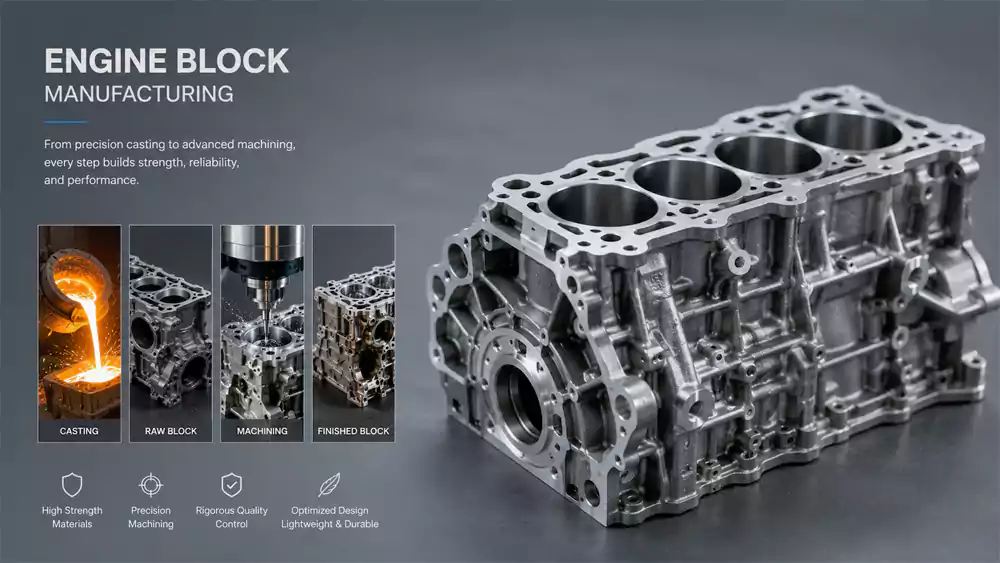
After more than 20 years working in casting and machining, I have learned one simple lesson: machining can improve precision, but it cannot repair a poor casting. The quality of a custom-manufactured engine block is determined the moment molten metal is poured into the mold. Every subsequent manufacturing step simply serves to maintain—or compromise—that initial quality.
What Is an Engine Block?
An engine block may look like a simple metal housing, but it is the structural core of every internal combustion engine. It supports the cylinders, crankshaft, coolant passages, lubrication system, and cylinder head while maintaining precise alignment under high temperature and combustion pressure.
The engine block provides the strength and rigidity needed to support all major engine components. It must withstand combustion pressure, transfer heat efficiently, and maintain dimensional stability throughout the engine's service life.
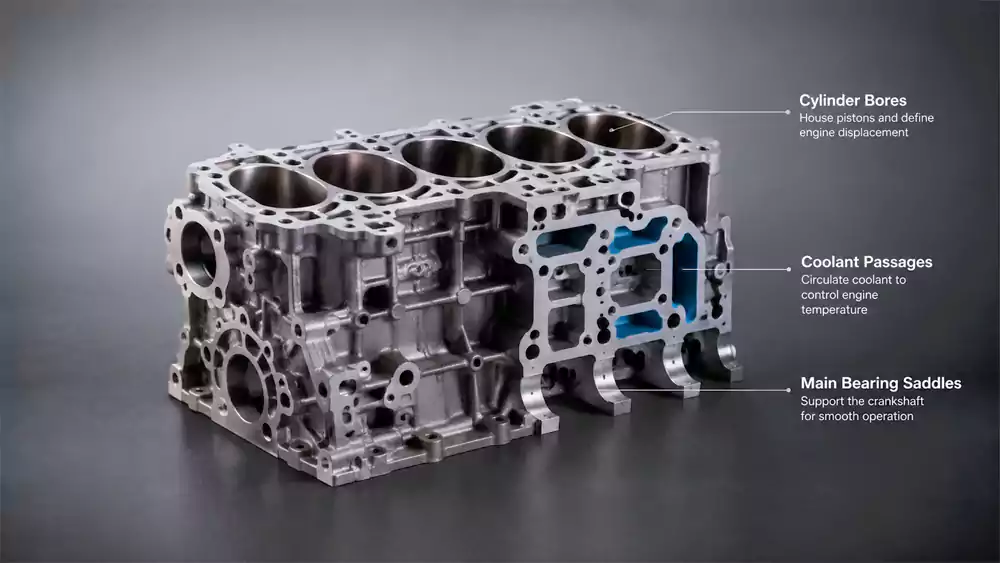
The exact design varies between inline, V-type, and boxer engines, but every engine block performs the same basic functions: supporting moving components, containing combustion forces, and providing passages for cooling and lubrication.
From my experience, buyers often focus on machining tolerances. In reality, internal casting quality has a much greater influence on long-term reliability. Defects such as porosity, shrinkage, or distortion cannot be completely removed after casting, regardless of how accurate the machining process is.
How to Choose the Right Materials for Engine Block Manufacturing?
Selecting the right material is not simply a matter of comparing strength values. The material must match the engine's operating conditions, production volume, weight targets, and manufacturing process.
Gray cast iron and aluminum alloys are the most common engine block materials. Cast iron offers excellent strength, wear resistance, and dimensional stability, while aluminum significantly reduces weight and improves heat dissipation. The right choice depends on the engine's performance requirements rather than a single material property.
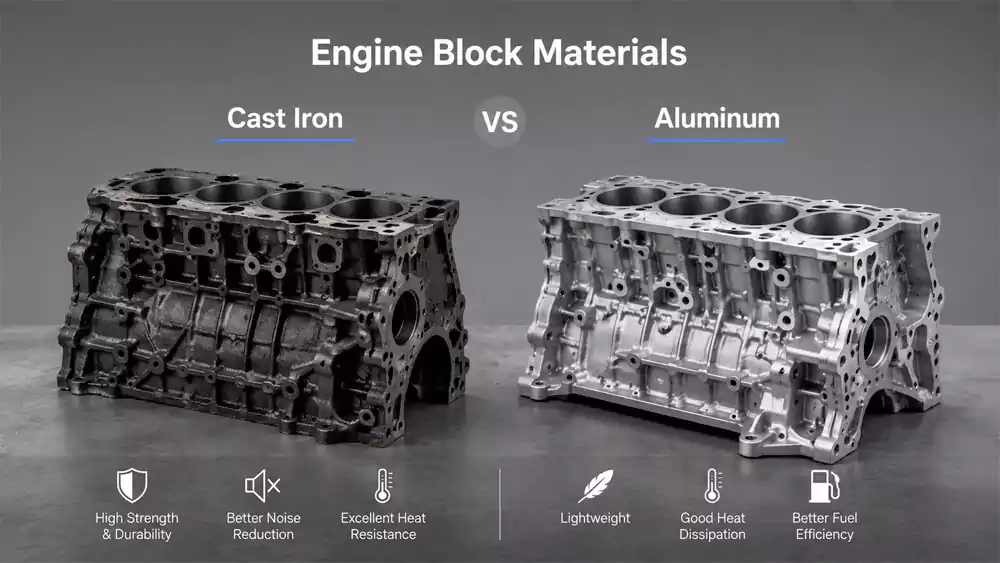
Material selection influences every stage of production, from mold design and casting behavior to heat treatment and machining. Over the years, I have found that understanding how a material behaves during manufacturing is often more valuable than simply reading its mechanical specifications.
How Are Engine Blocks Manufactured?
Even the best engine block design can fail if the manufacturing process is not properly controlled. In my experience, consistent quality comes from controlling every production step rather than relying on final inspection.
Engine blocks are typically manufactured through casting, heat treatment, CNC machining, and quality inspection. Each stage directly affects dimensional accuracy, mechanical strength, and long-term engine reliability. Defects introduced during casting cannot be completely corrected later through machining.
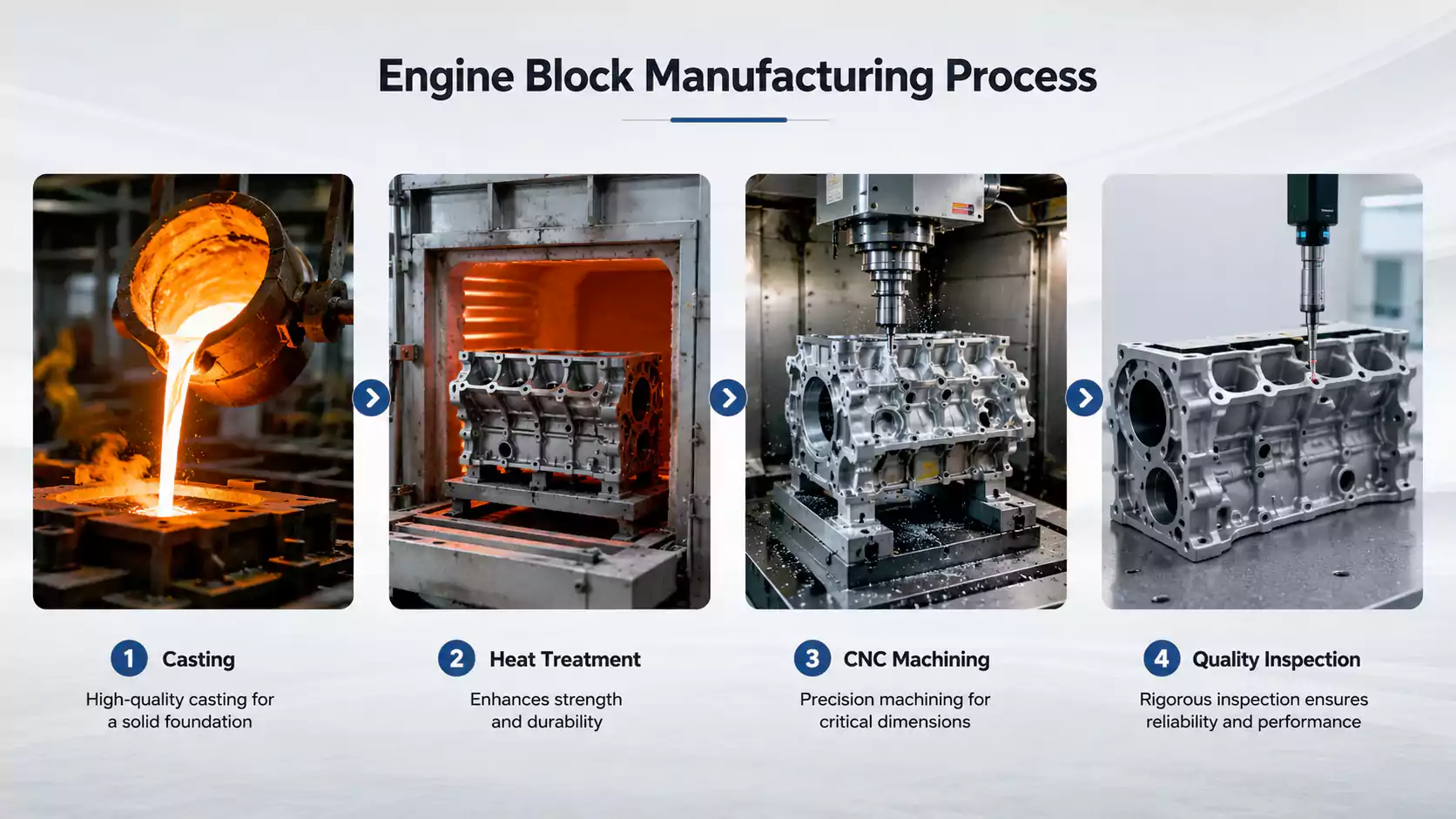
Over the years, I have seen customers focus heavily on machining tolerances while paying little attention to the casting process. In reality, machining only shapes the final dimensions. The true quality of an engine block is established much earlier when the molten metal solidifies inside the mold.
Typical Engine Block Manufacturing Process
| Manufacturing Stage | Purpose |
|---|---|
| Pattern & Mold Design | Create accurate casting geometry and gating system |
| Metal Melting & Casting | Produce a sound casting with minimal internal defects |
| Heat Treatment | Improve strength, hardness, and dimensional stability |
| Rough CNC Machining | Remove machining allowance and establish reference surfaces |
| Finish Machining | Machine cylinder bores, deck surface, bearing journals, and threaded holes |
| Inspection & Testing | Verify dimensions, material quality, and internal integrity |
Casting Quality Determines Everything
The casting process is the foundation of engine block manufacturing. Whether using gray cast iron, CGI, or aluminum alloys, the objective is always the same: produce a dense, defect-free casting with uniform mechanical properties.
Several common casting defects can significantly reduce engine reliability:
- Gas porosity
- Shrinkage cavities
- Cold shuts
- Sand inclusions
- Hot cracking
Once these defects exist inside the casting, CNC machining cannot remove them unless they happen to be located on the machined surface. This is why experienced manufacturers invest heavily in mold simulation, gating design, temperature control, and process validation before production begins.
Precision Machining Creates Functional Accuracy
After casting and heat treatment, the engine block moves into CNC machining. This stage establishes the precise dimensions required for engine assembly.
Critical machining operations typically include:
- Cylinder bore machining and honing
- Deck surface milling
- Main bearing bore machining
- Crankshaft journal alignment
- Thread machining
- Oil gallery drilling
Modern multi-axis machining centers allow these operations to be completed with excellent consistency. However, machining accuracy depends on a stable casting. If the casting has excessive residual stress or distortion, achieving tight tolerances becomes much more difficult.
Quality Inspection Throughout Production
Final inspection should verify manufacturing quality rather than discover major problems. I always recommend multiple inspection points throughout production instead of relying only on the finished part.
Typical inspection methods include:
| Inspection Method | Purpose |
|---|---|
| Chemical composition analysis | Verify alloy specification |
| Mechanical property testing | Confirm strength and hardness |
| Coordinate Measuring Machine (CMM) | Check dimensional accuracy |
| X-ray inspection | Detect internal porosity and shrinkage |
| Pressure leak testing | Verify coolant and oil passage integrity |
| Surface roughness measurement | Ensure proper sealing surfaces |
Combining process control with inspection provides much more reliable results than inspection alone.
Case Study: Aluminum Turbocharged Engine Block
One project that stands out involved a custom aluminum engine block for a high-performance turbocharged application. The customer required both reduced weight and high structural rigidity while maintaining excellent machining accuracy.
| Parameter | Specification |
|---|---|
| Material | A356-T6 Aluminum Alloy |
| Casting Process | Precision Sand Casting |
| Heat Treatment | T6 Solution & Aging |
| Overall Dimensions | 520 × 410 × 330 mm |
| Weight | 34.8 kg |
| Cylinder Bore Diameter | 86.00 ± 0.010 mm |
| Deck Flatness | ≤0.03 mm |
| Main Bearing Alignment | ≤0.02 mm |
| Internal Pressure Test | 0.6 MPa / 10 minutes |
| NDT Method | Digital X-ray Inspection |
During trial production, early castings showed minor porosity near one coolant passage. Instead of increasing machining allowance, we redesigned the gating system and optimized metal flow simulation. The porosity rate dropped significantly, machining yield improved, and dimensional consistency became much more stable in mass production.1
This project reinforced a lesson I have learned repeatedly throughout my career: good machining begins with good casting. Process optimization at the casting stage almost always delivers greater value than attempting to correct problems later in production.
What Design Factors Affect Engine Block Performance?
A well-manufactured engine block can still underperform if the design is not optimized for its intended application. Material and manufacturing provide the foundation, but structural design determines how the engine performs over thousands of operating hours.
Engine block performance depends on structural rigidity, cylinder wall thickness, cooling efficiency, lubrication design, and weight optimization. A balanced design improves durability, thermal stability, and machining consistency while reducing stress concentration and distortion.
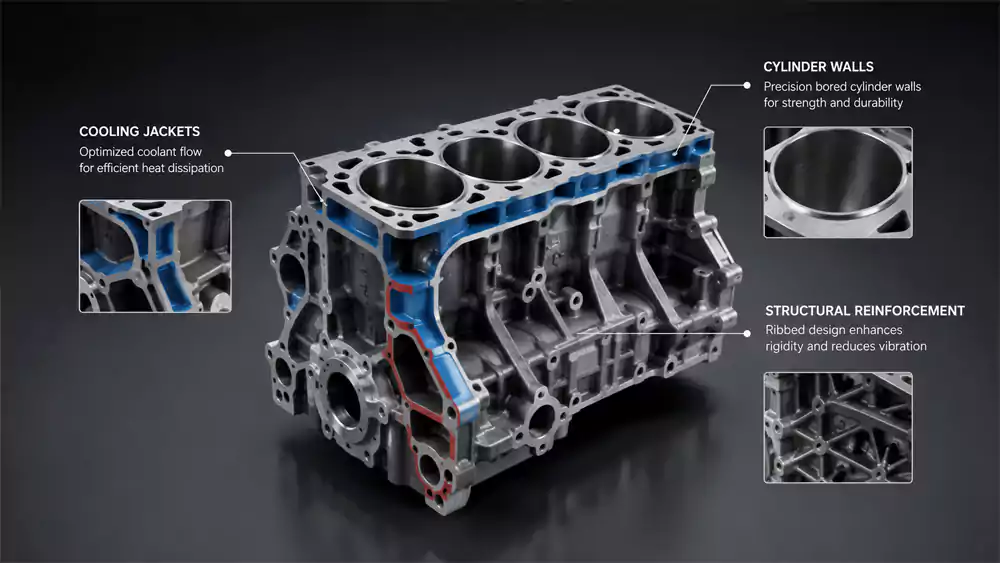
Throughout my career, I have noticed that successful engine block projects rarely rely on a single improvement. Instead, they result from balancing multiple design factors. Increasing strength often increases weight.2 Reducing weight may affect stiffness. Good engineering is about finding the right compromise rather than maximizing one parameter.
Key Design Factors
| Design Factor | Why It Matters |
|---|---|
| Cylinder wall thickness | Affects strength, heat transfer, and machining stability |
| Cooling jacket layout | Controls engine operating temperature and thermal distortion |
| Main bearing support | Maintains crankshaft alignment under heavy loads |
| Deck structure | Influences cylinder sealing and combustion pressure resistance |
| Weight optimization | Improves vehicle efficiency without sacrificing rigidity |
| Machining allowance | Ensures dimensional accuracy after casting |
Balancing Strength and Weight
Modern engines continue to move toward lightweight construction, especially in passenger vehicles and hybrid powertrains. Aluminum alloys have become increasingly popular because they reduce overall vehicle weight and improve heat dissipation. However, reducing weight should never come at the expense of structural integrity.
One common design choice is the difference between open-deck and closed-deck engine blocks.
| Design Type | Advantages | Typical Applications |
|---|---|---|
| Open Deck | Lower weight, better coolant flow, easier manufacturing | Passenger cars |
| Closed Deck | Higher rigidity, better cylinder support | High-performance and turbocharged engines |
The right choice depends on the engine's intended operating conditions. High-output engines generally require greater structural support, while standard passenger vehicles often prioritize weight reduction and manufacturing efficiency.
Designing for Manufacturing
Good engine block design should also simplify production.
I always encourage customers to consider manufacturability during the design stage instead of after the drawings are complete. Small design changes can significantly improve casting quality, machining efficiency, and production cost.
Examples include:
- Maintaining uniform wall thickness to reduce shrinkage.3
- Designing smooth internal transitions to improve metal flow.
- Allowing sufficient machining allowance without adding unnecessary weight.
- Positioning ribs to increase stiffness while minimizing material usage.
- Optimizing coolant passage geometry for both casting and cooling performance.
When design engineers and manufacturing engineers work together early in a project, production usually becomes more stable and quality problems are easier to prevent.
Conclusion
An engine block is much more than a large metal casting. Its performance is determined by the combination of material selection, casting quality, precision machining, and intelligent structural design. After more than two decades in casting and machining, I still believe the same principle holds true today: quality starts with the casting process, and every manufacturing decision after that should protect the integrity established at the very beginning.
-
"2002-4.4 Modeling of porosity formation and feeding flow in steel ...", https://beckermann.lab.uiowa.edu/sites/beckermann.lab.uiowa.edu/files/2023-10/2002-4.4%20Modeling%20of%20porosity%20formation%20and%20feeding%20flow%20in%20steel%20casting.pdf. Process-optimization case studies and foundry research on how gating design and metal-flow simulation reduce porosity support the plausibility that changing gating can lower porosity and improve downstream manufacturing yield; however, the specific magnitude (“significantly”) and the reported metrics require the missing project-specific data or an audited report. Evidence role: case_reference; source type: paper. Supports: The porosity rate dropped significantly, machining yield improved, and dimensional consistency became much more stable in mass production.. Scope note: The article does not provide measurable before/after porosity rates or yield statistics, so external support can only validate the general expectation, not confirm the particular results. ↩
-
"Mechanics of Materials For Dummies", https://cheiodasideia.libertar.org/wp-content/uploads/2022/06/Allen_Mechanics.of_.Materials.For_.Dummies.pdf. This claim aligns with basic structural mechanics: increasing section strength typically requires increased cross-sectional area or material, which increases mass; however, actual outcomes depend on geometry, material properties, and design constraints. Evidence role: mechanism; source type: education. Supports: Increasing strength often increases weight.. Scope note: General mechanical-relationships support the trend, but the article’s statement is not quantified and may not hold in every case (e.g., material/shape optimization). ↩
-
"Casting Shrinkage Rules: Prevent Shrinkage Defects | DFM", https://manufyn.com/resources/design-guides/casting/shrinkage-rules/. Foundry and materials-processing references describe that non-uniform section thickness in casting can promote uneven solidification and feeding requirements, increasing shrinkage defects; maintaining more uniform wall thickness is a common design guideline to reduce shrinkage and related casting porosity risks. Evidence role: general_support; source type: institution. Supports: Maintaining uniform wall thickness helps reduce shrinkage.. Scope note: Casting defect outcomes depend on alloy, mold design, gating/feeding, and process parameters; uniform thickness helps but does not guarantee defect-free castings. ↩