
Finding a supplier that can machine a cylinder head is easy. Finding one that can consistently produce a defect-free casting is much harder. Many projects fail because buyers focus on machining precision instead of casting quality.
Automotive cylinder heads are manufactured through two main processes: casting and CNC machining. Casting creates the complex internal structure, while machining finishes the precision sealing and functional surfaces. From my experience, about 70% of cylinder head quality is determined during casting, and only 30% during machining.
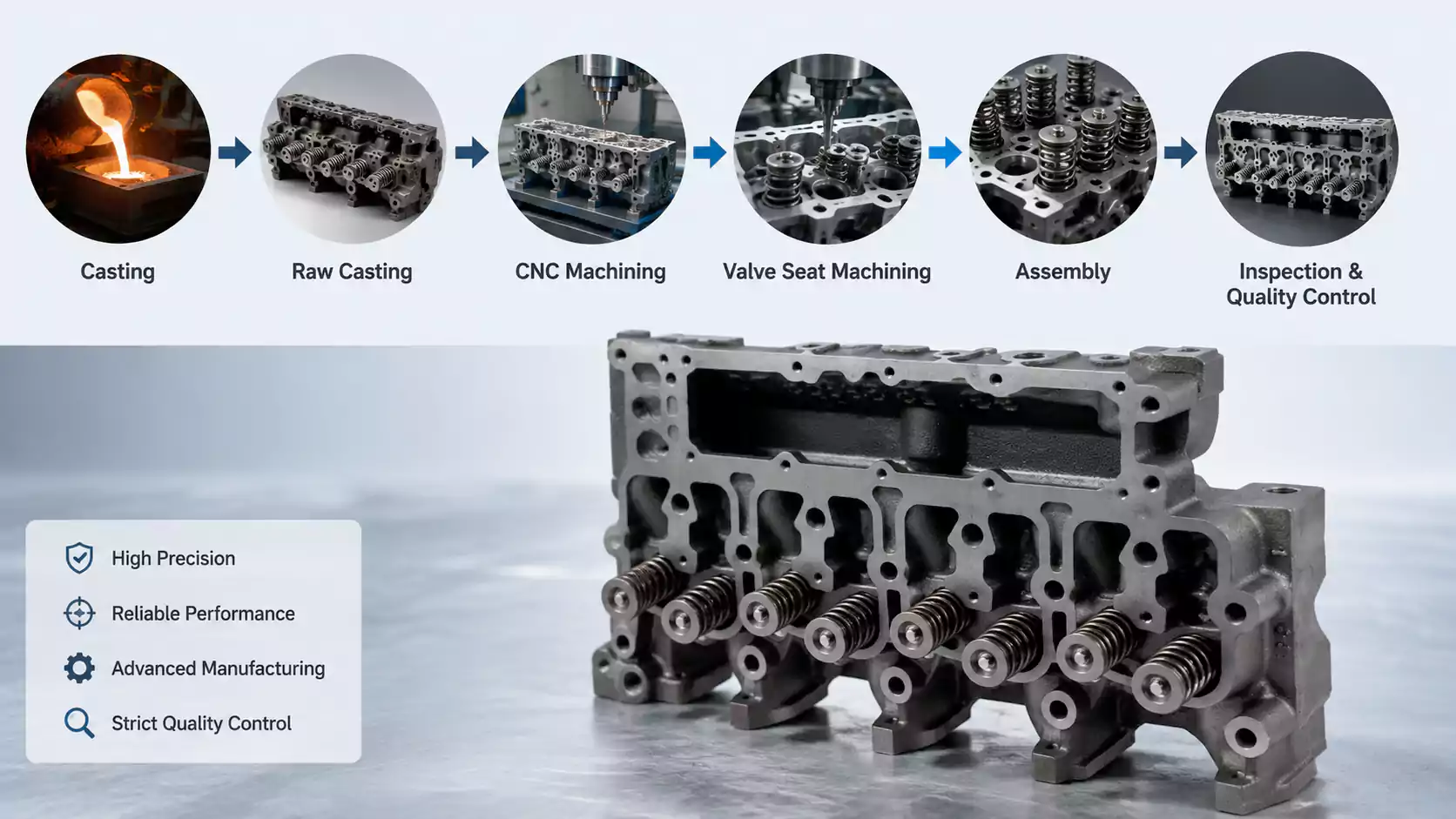
Most buyers compare CNC tolerances when requesting quotations because they are easy to measure. However, the most important quality factors—metal flow, shrinkage, porosity, and internal integrity—are established during casting. Once internal defects exist, no machining operation can remove them. That is why I always evaluate the foundry before evaluating the machine shop.
How Are Automotive Cylinder Heads Manufactured?
Many buyers assume cylinder heads are simply machined from metal. In reality, almost every production cylinder head starts as a casting and is then finished by CNC machining.
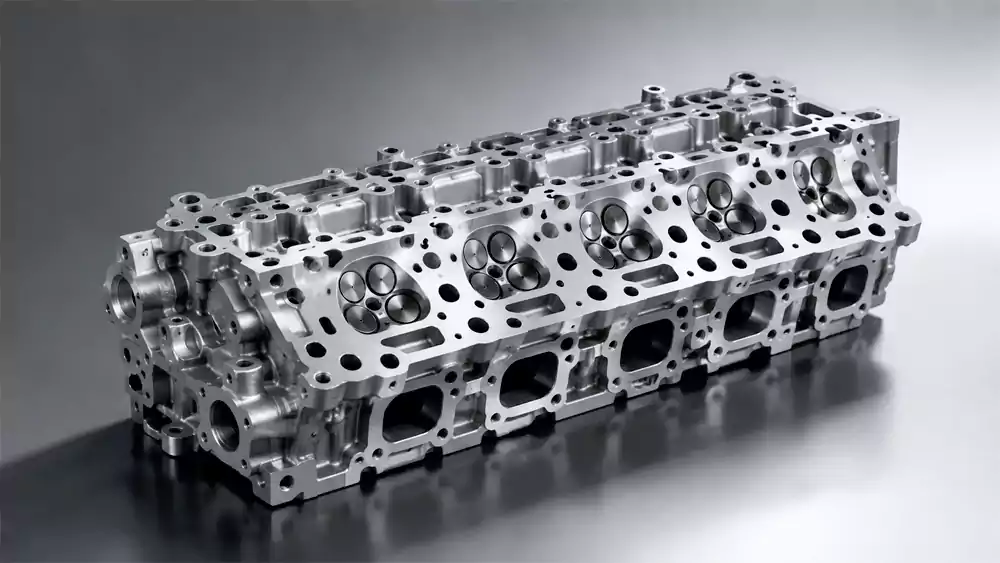
Casting forms the complex internal water jackets, oil passages, and combustion chambers. CNC machining then produces the sealing surfaces, valve seats, bearing bores, threaded holes, and other critical features required for engine assembly. Both processes are essential, but machining can only refine what casting has already created.
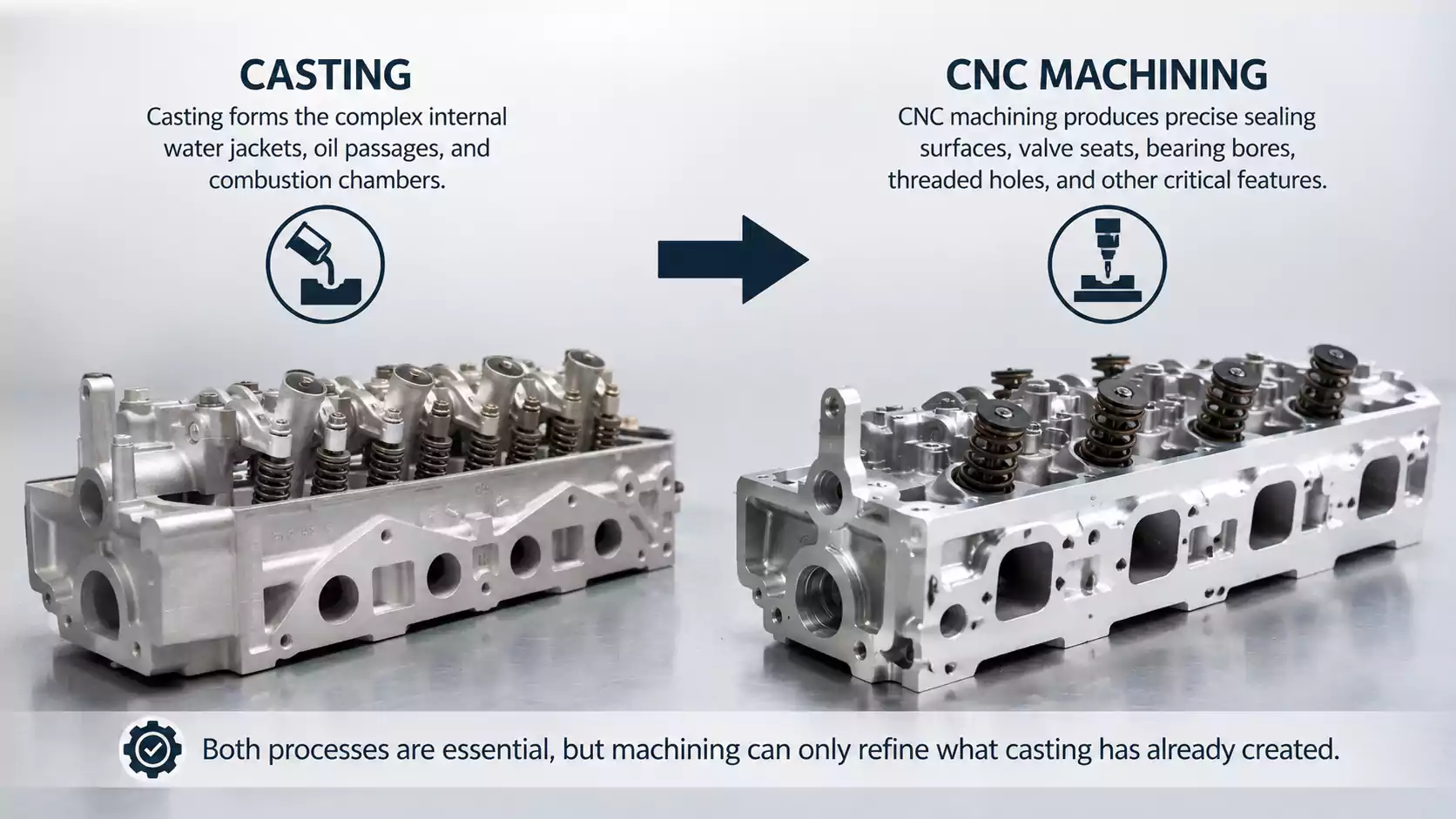
The typical manufacturing process includes four major stages:
| Stage | Purpose |
|---|---|
| Casting | Forms the near-net-shape cylinder head and all internal passages |
| Heat Treatment | Improves strength and dimensional stability |
| CNC Machining | Finishes critical functional surfaces and precision features |
| Inspection | Verifies dimensions, pressure integrity, and internal quality |
From my experience, the best Cylinder Head Manufacturing projects rarely begin with discussions about machining tolerance. They begin with careful control of casting quality, where metal flow, shrinkage, and process stability are established. Once those fundamentals are right, CNC machining simply brings an already good casting to its final precision.supplier.
Cylinder Head Casting vs. Machining: What Are the Key Differences?
Many buyers ask me whether they should pay more attention to casting quality or machining precision. It sounds like a simple question, but the answer often determines whether a cylinder head performs reliably for years or develops problems after only a short service life.
Casting and machining serve completely different purposes. Casting creates the cylinder head's internal structure and mechanical integrity, while CNC machining delivers the precision required for sealing, assembly, and engine performance. A high-quality cylinder head requires excellence in both processes, but machining can never repair defects created during casting.
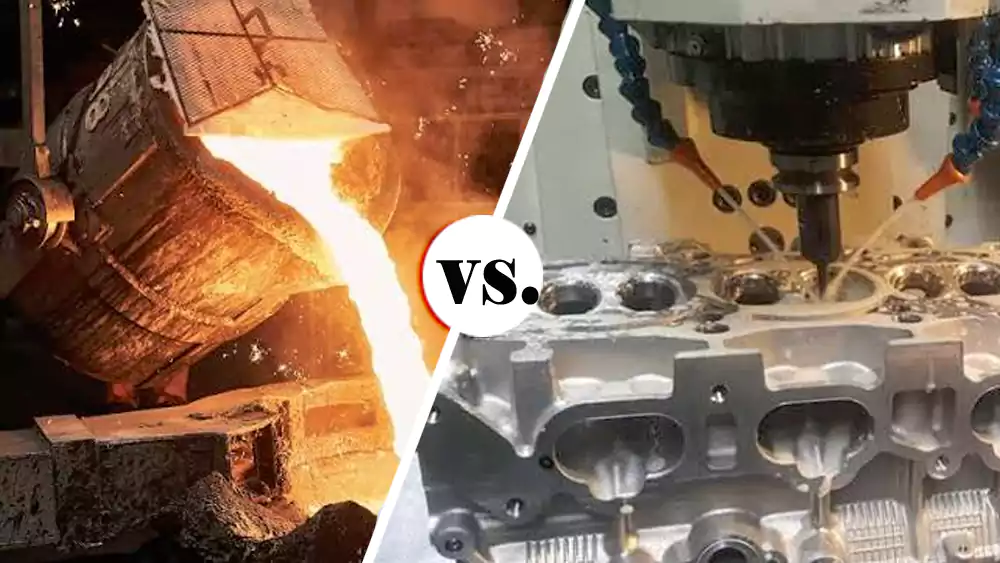
After more than two decades in metal manufacturing, I have noticed that buyers often spend too much time discussing machining tolerances and not enough time asking how the casting is produced. A supplier may advertise ±0.01 mm machining accuracy, but that number tells only part of the story. If the casting contains internal shrinkage, gas porosity, or core shift, those defects remain hidden beneath an excellent machined surface.1 In other words, machining improves what already exists—it does not create quality from a poor casting.
Casting Determines the Foundation
The primary role of casting is to produce the complex geometry that defines the cylinder head.
Cooling jackets, oil passages, combustion chambers, intake runners, and exhaust ports are all formed during casting. These internal features cannot be manufactured economically through machining alone.
For most production cylinder heads, manufacturers use gravity casting or low-pressure die casting. However, Investment Casting is an excellent solution for low-volume production, prototype development, motorsport applications, and highly customized engine components where exceptional dimensional consistency and complex geometries are required.
From my experience, a quality casting depends on far more than selecting the right alloy. Mold design, gating layout, riser placement, pouring temperature, filling speed, and solidification control all work together to determine the final result.
| Casting Factor | Influence on Quality |
|---|---|
| Metal flow | Complete mold filling without cold shuts |
| Feeding system | Reduces shrinkage cavities |
| Core positioning | Ensures accurate internal passages |
| Solidification control | Improves structural integrity |
| Process consistency | Maintains repeatable production quality |
Whenever I visit a foundry, I pay more attention to the pouring process than to the machine shop. That is where the real quality of a cylinder head is established.
Precision CNC Machining Delivers Functional Accuracy
If casting creates the foundation, Precision CNC Machining transforms that foundation into a functional engine component.
The machining stage finishes every critical surface that directly affects engine assembly and performance. Deck surfaces must seal perfectly against the engine block. Valve seats require micron-level concentricity.2 Camshaft bearing bores must maintain precise alignment to reduce friction and wear.
Modern multi-axis machining centers also improve production efficiency by completing multiple operations in fewer setups, reducing accumulated positioning errors while maintaining excellent consistency across production batches.
Typical machining operations include:
- Deck surface milling
- Valve guide and valve seat machining
- Camshaft bearing boring
- Spark plug and injector hole machining
- Thread milling and tapping
- Intake and exhaust flange machining
- Precision drilling of oil galleries
This is also where Custom Machining of Engine System Parts becomes especially valuable. Every engine program has unique design requirements, whether for passenger vehicles, commercial engines, racing applications, or industrial equipment. Flexible CNC machining allows manufacturers to customize mounting features, combustion chamber geometry, cooling interfaces, and auxiliary connections while maintaining tight dimensional control.
Still, I always remind customers of one important fact. CNC machines remove material; they do not improve the internal soundness of the metal itself. If defects exist beneath the surface, even the most advanced machining center cannot eliminate them.
Casting vs. Machining: Which Matters More?
I often summarize the relationship with one simple sentence:
For cylinder heads, quality is about 70% determined by the casting and 30% by the machining.
Some engineers are surprised when they hear this, but years on the shop floor have reinforced that belief. A well-designed casting gives machining a stable foundation. Precision machining then unlocks the full performance of that casting by creating the critical sealing and functional surfaces that every engine depends on.
The strongest manufacturing partners understand that these two processes are not competitors. They are complementary steps within the same production system, and success depends on controlling both with equal discipline.
Which Manufacturing Solution Is Best for Your Cylinder Head Project?
Choosing the right manufacturing solution is not simply about selecting a casting process or requesting tighter machining tolerances. The best approach depends on your production volume, engine design, performance requirements, and cost targets. A supplier should recommend the process that fits your application instead of forcing every project into the same production method.
For most cylinder head projects, the ideal solution combines a well-controlled casting process with precision CNC machining. High-volume automotive programs often use gravity or low-pressure die casting, while low-volume, prototype, or high-performance applications may benefit from investment casting and custom machining.
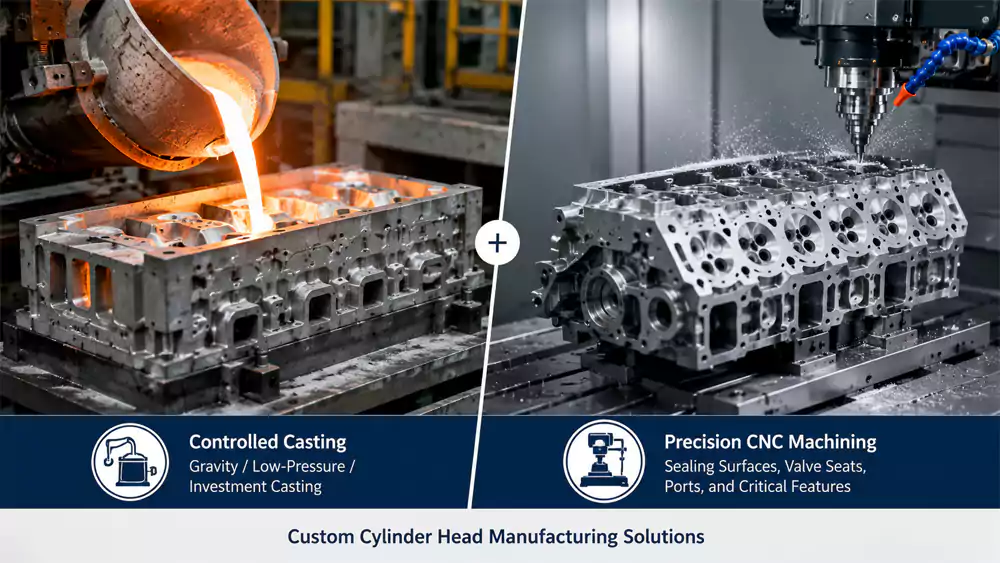
Every cylinder head project has different priorities. A passenger vehicle manufacturer may focus on production efficiency and cost. A racing engine builder may prioritize lightweight design and airflow optimization. Industrial engines often require long-term durability under continuous heavy loads. These differences affect both the casting process and the machining strategy.
| Project Type | Recommended Manufacturing Solution |
|---|---|
| High-volume passenger vehicles | Gravity or low-pressure casting + automated CNC machining |
| Heavy-duty commercial engines | High-strength casting + extensive inspection + CNC machining |
| Motorsport & performance engines | Investment Casting + Precision CNC Machining |
| Prototype & low-volume production | Investment Casting + Custom Machining of Engine System Parts |
When Is Investment Casting the Better Choice?
Although most production cylinder heads are manufactured using permanent mold or low-pressure casting, Investment Casting offers clear advantages for specialized applications.
Because wax patterns provide exceptional dimensional accuracy, investment casting can produce highly complex geometries with excellent surface finish and minimal draft angles. This makes it an attractive solution for prototype cylinder heads, racing engines, concept vehicles, and other custom engine programs where design flexibility is more important than maximum production speed.
For low-volume production, investment casting can also reduce tooling investment while shortening product development cycles.
Why Precision CNC Machining Still Matters
No casting process alone can produce the accuracy required for engine assembly.3
After casting, Precision CNC Machining ensures that every functional surface meets engineering specifications. Deck flatness, valve seat concentricity, camshaft bore alignment, and threaded hole locations all directly influence sealing performance, combustion efficiency, and engine reliability.
Today, five-axis machining centers allow manufacturers to complete complex operations with fewer setups, improving consistency while reducing cumulative positioning errors.
For customers developing new engine platforms, machining flexibility is equally important. Many projects require Custom Machining of Engine System Parts, including modified combustion chambers, special mounting interfaces, sensor ports, or unique cooling configurations. A capable machining team can adapt quickly to engineering revisions without sacrificing precision.
Case Study: Custom Performance Cylinder Head
One project that stands out in my experience involved a customer developing a lightweight cylinder head for a high-performance turbocharged engine. The customer needed both excellent thermal performance and tight dimensional control while keeping development lead time as short as possible.
Instead of focusing only on machining tolerance, we first optimized the casting process to improve metal flow and minimize shrinkage in the combustion chamber bridge. Only after validating the casting quality did we finalize the CNC machining program.
| Item | Project Data |
|---|---|
| Application | Turbocharged performance engine |
| Material | A356-T6 Aluminum Alloy |
| Manufacturing Process | Investment Casting + Precision CNC Machining |
| Annual Volume | 600 pieces |
| Deck Flatness | ≤0.03 mm |
| Valve Seat Concentricity | ≤0.02 mm |
| X-ray Inspection | 100% |
| Pressure Test | 0.6 MPa / 5 min |
| Result | Passed validation on the first production batch with no internal leakage defects |
This project reinforced a lesson I have learned many times over the years. Customers often remember the machining accuracy because those numbers appear on inspection reports. However, the stable machining results were only possible because the casting quality had already been controlled from the very beginning. A sound casting made precision machining predictable, repeatable, and efficient.
How to Choose the Right Cylinder Head Manufacturing Partner?
Selecting the right supplier is often more important than choosing a specific manufacturing process. Two suppliers may use similar equipment, yet deliver completely different results because their process control, engineering experience, and quality systems are not the same.
A reliable cylinder head manufacturer should demonstrate strong capabilities in both casting and machining. More importantly, they should understand how these two processes work together to produce consistent, defect-free components rather than treating them as separate operations.
When I evaluate a manufacturing partner, I usually look beyond machine specifications and production capacity. I want to understand how they control the entire manufacturing process.
A trustworthy supplier should be able to answer questions such as:
- How do you prevent shrinkage and porosity during casting?
- What inspection methods verify internal quality?
- How do you maintain dimensional consistency between production batches?
- Can you provide complete material certifications and inspection reports?
- Do your casting and machining teams work together during product development?
- Can you support prototype, low-volume, and mass production under one quality system?
The best suppliers treat manufacturing as one continuous process instead of two independent departments. Engineering, casting, heat treatment, machining, and quality inspection should all work toward the same goal—producing a cylinder head that performs reliably throughout its service life.
Conclusion
Successful Cylinder Head Manufacturing is not about choosing casting over machining. It is about controlling every stage of the manufacturing process to deliver consistent quality from the inside out. When casting quality, precision machining, and engineering experience come together, reliable performance becomes the natural result.
-
"In-process detection of surface porosity in machined castings", https://www.sciencedirect.com/science/article/abs/pii/S0890695508002496. Foundry literature on casting defects (e.g., shrinkage, gas porosity, and core shift) describes how these internal discontinuities can persist even after subsequent machining removes only near-surface material; thus, surface-finish metrics alone may not reveal subsurface soundness. Evidence role: general_support; source type: encyclopedia. Supports: If the casting contains internal shrinkage, gas porosity, or core shift, those defects remain hidden beneath an excellent machined surface.. Scope note: Contextual support: sources can explain mechanisms of defect persistence/visibility, but may not quantify the extent to which machining always masks these specific defects for every cylinder-head process. ↩
-
"Valve-seat components in a diesel engine: a tribological approach to ...", https://www.mechanics-industry.org/articles/meca/full_html/2021/01/mi210081/mi210081.html. Technical references on valve-seat machining and cylinder-head sealing state that valve seats are machined to controlled concentricity and positional tolerances to ensure proper sealing and durability; the “micron-level” descriptor should be supported by published tolerance standards or industry guidance for seat concentricity. Evidence role: statistic; source type: government. Supports: Valve seats require micron-level concentricity.. Scope note: Micron-level concentricity may vary by engine design, valve-seat diameter, and manufacturer standards; the supporting evidence should ideally provide representative tolerance values or explain how they are specified (e.g., relative runout). ↩
-
"An Introduction to Cylinder Head Machining - SAM Tech", https://samtech.edu/programs/associate-degree-program/an-introduction-to-cylinder-head-machining/. Reference materials on cylinder head manufacturing note that critical mating surfaces (e.g., deck, valve seat features, and bore alignment) are commonly finished by machining operations after casting to meet functional tolerances, supporting the claim that casting alone typically cannot achieve final assembly accuracy. Evidence role: expert_consensus; source type: education. Supports: No casting process alone can produce the accuracy required for engine assembly.. Scope note: The support is typical industry practice; some designs may use finishing reduction or near-net approaches with different tolerance targets. ↩