
Turbine blades often operate in temperatures that push materials to their limits. Yet many failures happen long before melting occurs, which creates costly downtime and unexpected maintenance.
The best turbine blade grain structure depends on operating temperature, stress, and service life requirements. Equiaxed blades offer the lowest cost, directional solidification (DS) provides a strong balance of cost and performance, and single crystal (SX) delivers the highest creep resistance for the most demanding turbine environments.
When I discuss turbine blade performance with aerospace and power generation customers, I often find that temperature receives most of the attention. What many engineers discover later is that grain boundary behavior has a greater influence on long-term blade life. Understanding how grain structure works can help buyers make better technical and commercial decisions.
What Is Turbine Blade Grain Structure and Why Does It Matter?
Many turbine blade failures appear to be heat-related. In reality, the root cause is often grain boundary movement under stress, which slowly weakens the material over time.
Turbine blade grain structure refers to the arrangement and orientation of metal crystals inside a blade. This structure directly affects creep resistance, fatigue life, crack growth behavior, and the blade's ability to withstand long-term exposure to high temperatures and mechanical loads.
Understanding Grain Boundaries
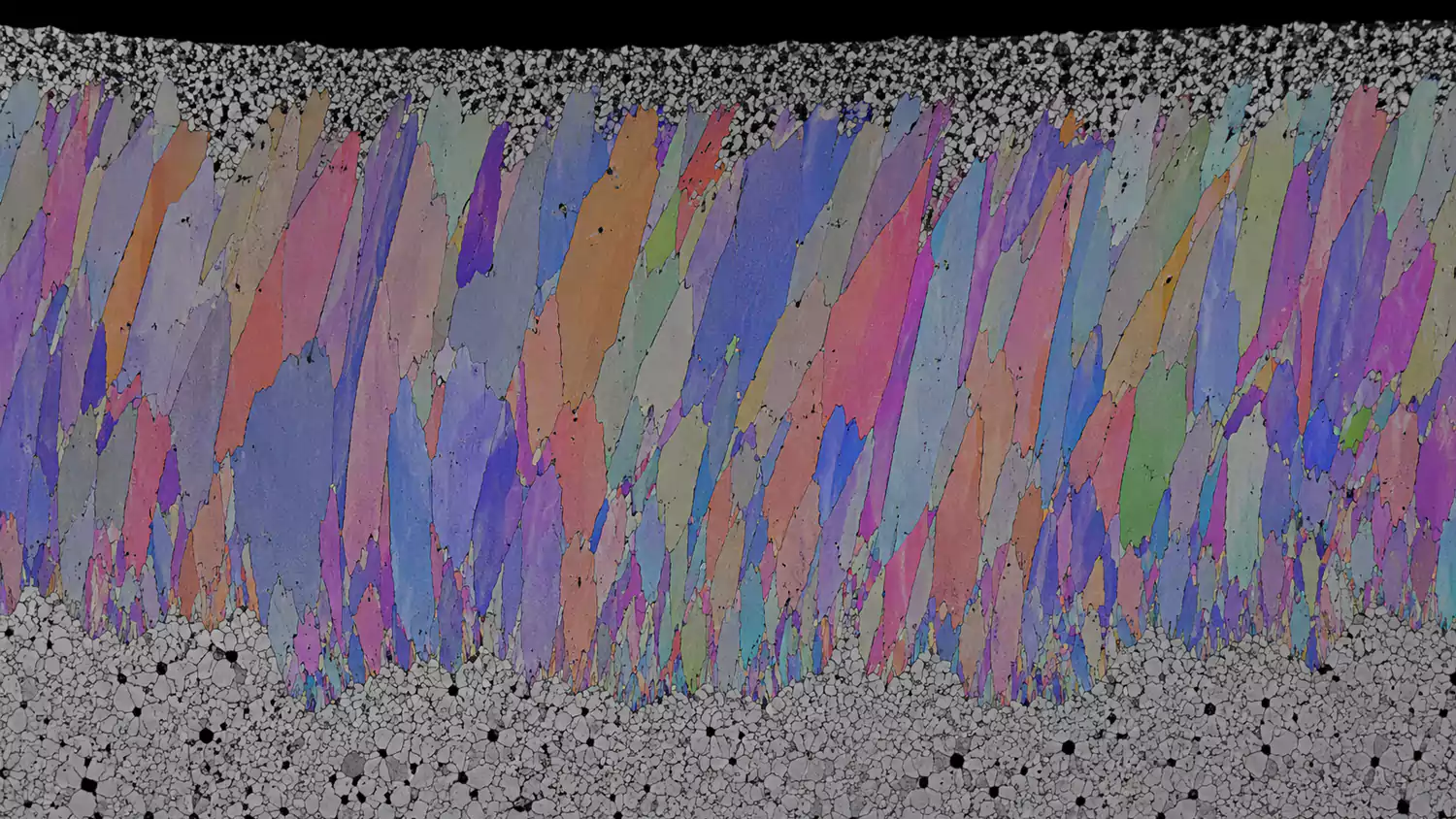
Every metal casting contains grains. Each grain has a different crystal orientation. The interfaces between these grains are called grain boundaries.
At elevated temperatures, grain boundaries become weak points. Under continuous stress, the grains slowly slide against each other. This process is known as grain boundary sliding.1
For turbine blades, this mechanism often controls component life more than the maximum operating temperature itself.
Why Grain Structure Matters in Turbine Applications
| Property | Influence of Grain Structure |
|---|---|
| Creep Resistance | Strongly affected |
| Thermal Fatigue Life | Strongly affected |
| Crack Propagation | Moderately affected |
| High-Temperature Strength | Strongly affected |
| Manufacturing Cost | Directly affected |
In my early years working on investment casting production lines, I saw several turbine blade investigations where material chemistry met specifications perfectly. Yet the blades still failed prematurely. The common factor was grain boundary behavior. Once customers understood this relationship, grain structure became a primary design consideration rather than an afterthought.
Equiaxed vs Directional Solidification vs Single Crystal: What Are the Differences?
Many sourcing teams focus on alloy selection first. Yet two blades made from the same alloy can perform very differently because of their grain structure.
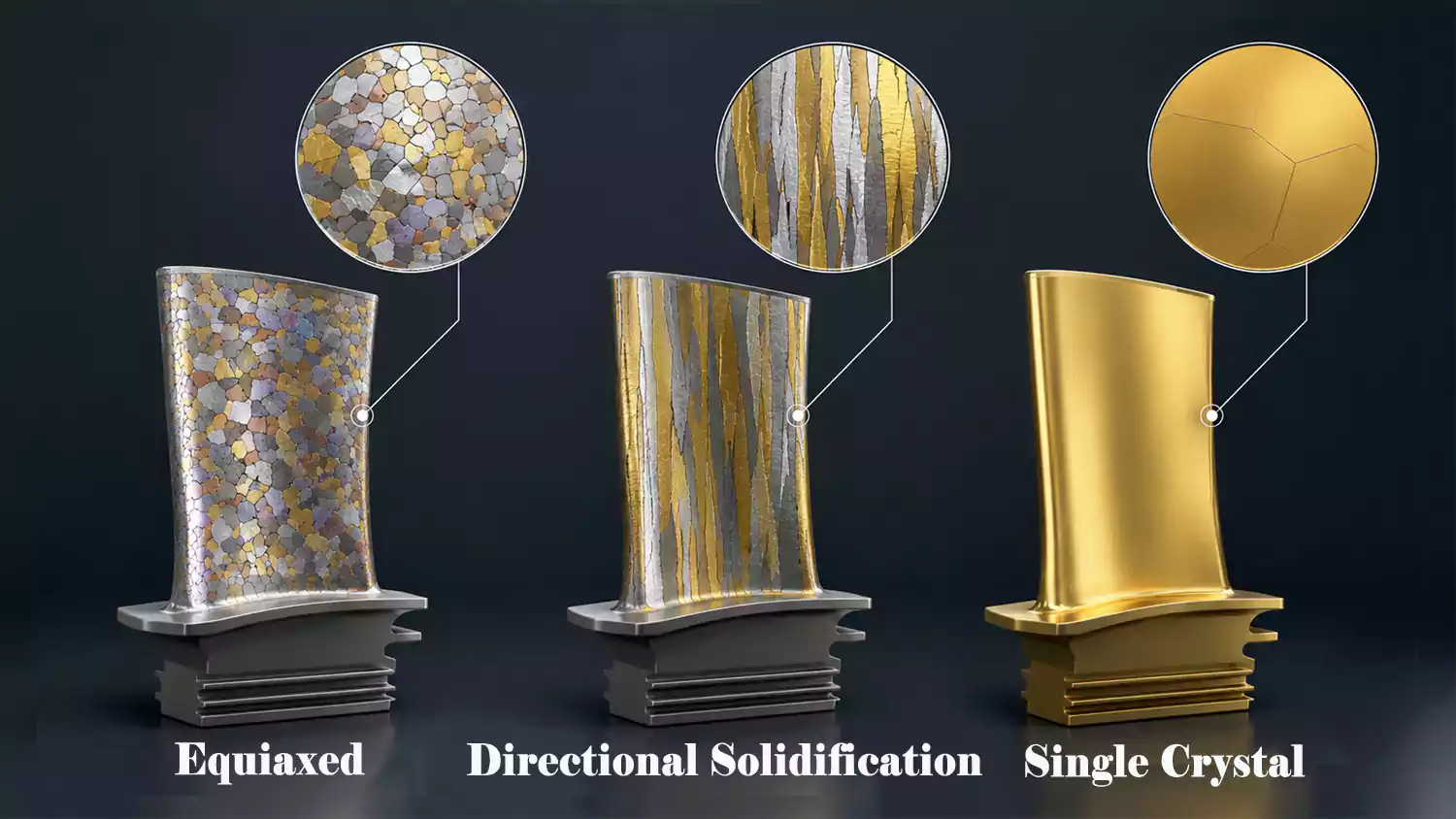
Equiaxed blades contain randomly oriented grains, directional solidification blades align grains along the primary stress direction, and single crystal blades eliminate grain boundaries entirely. As grain alignment improves, creep resistance and thermal fatigue performance increase, but manufacturing cost also rises.
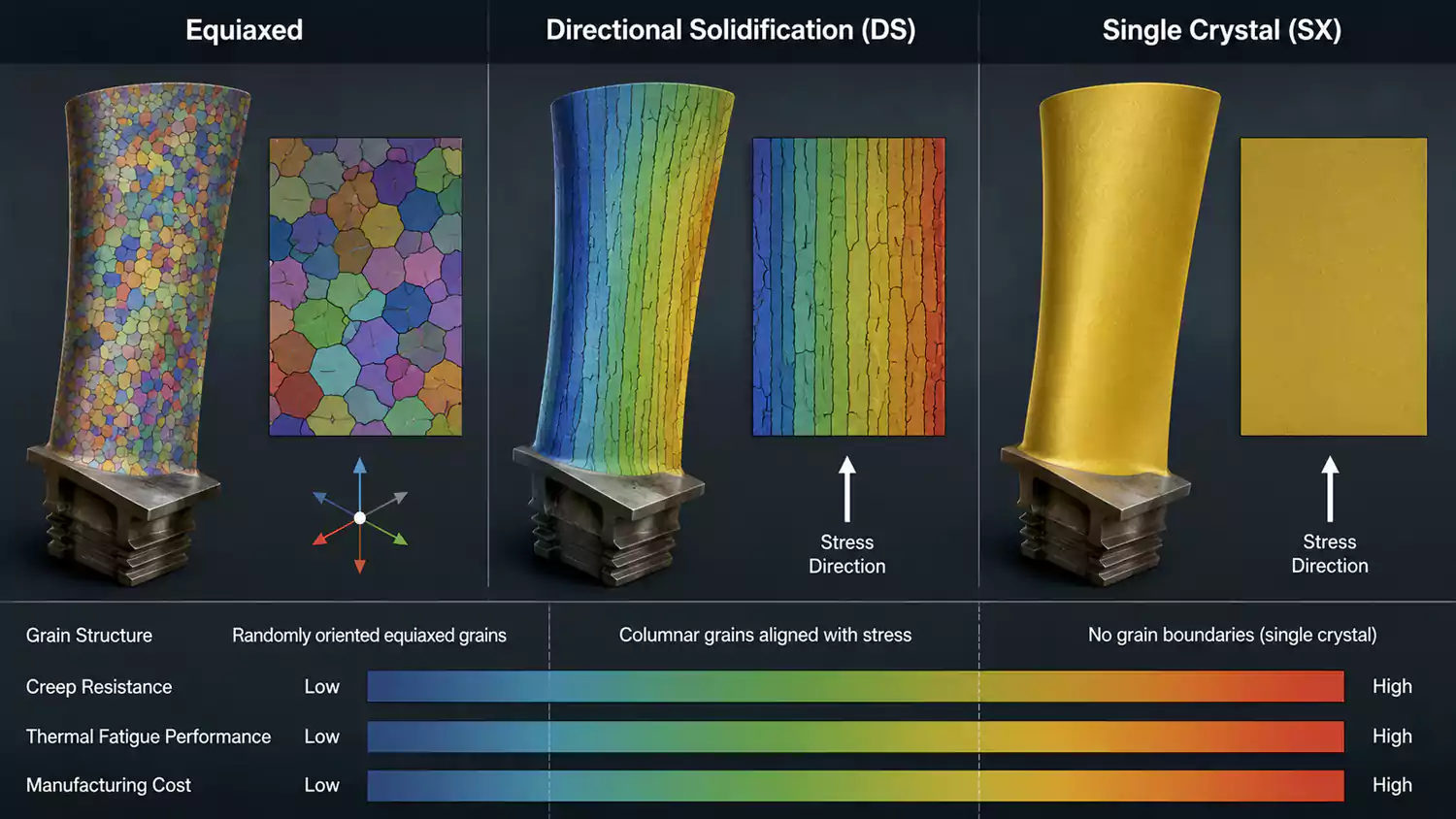
Side-by-Side Comparison
| Feature | Equiaxed | Directional Solidification | Single Crystal |
|---|---|---|---|
| Grain Orientation | Random | Aligned | Single Grain |
| Grain Boundaries | Many | Few Transverse Boundaries | None |
| Creep Resistance | Good | Very Good | Excellent |
| Thermal Fatigue | Good | Very Good | Excellent |
| Manufacturing Cost | Lowest | Medium | Highest |
| Yield Rate | Highest | Medium | Lowest |
Equiaxed Structure
Equiaxed blades are the most common and economical solution. They are suitable for moderate operating temperatures and lower stress environments.
The casting process is simpler and production yields are generally higher.
Directional Solidification Structure
DS blades contain elongated grains aligned with the primary loading direction.
This alignment reduces grain boundary sliding because fewer boundaries exist perpendicular to the applied stress.
In many industrial gas turbine applications, DS blades provide an excellent balance between performance and manufacturing cost.
Single Crystal Structure
SX blades eliminate grain boundaries completely.
Without grain boundaries, creep resistance improves dramatically. This makes SX technology the preferred choice for the hottest sections of modern aircraft engines.
The trade-off is significantly higher manufacturing complexity and cost.
Here's how I explain it to clients on the shop floor. Equiaxed is like stone—random and full of cracks. DS is like wood—strong along the grain. Single crystal is like rebar—no seams at all, so it takes the heaviest loads.
How Grain Structure Affects Creep Resistance and Thermal Fatigue Life
Many engineers assume higher alloy strength automatically means longer service life. In high-temperature turbine environments, grain structure often becomes the dominant factor.
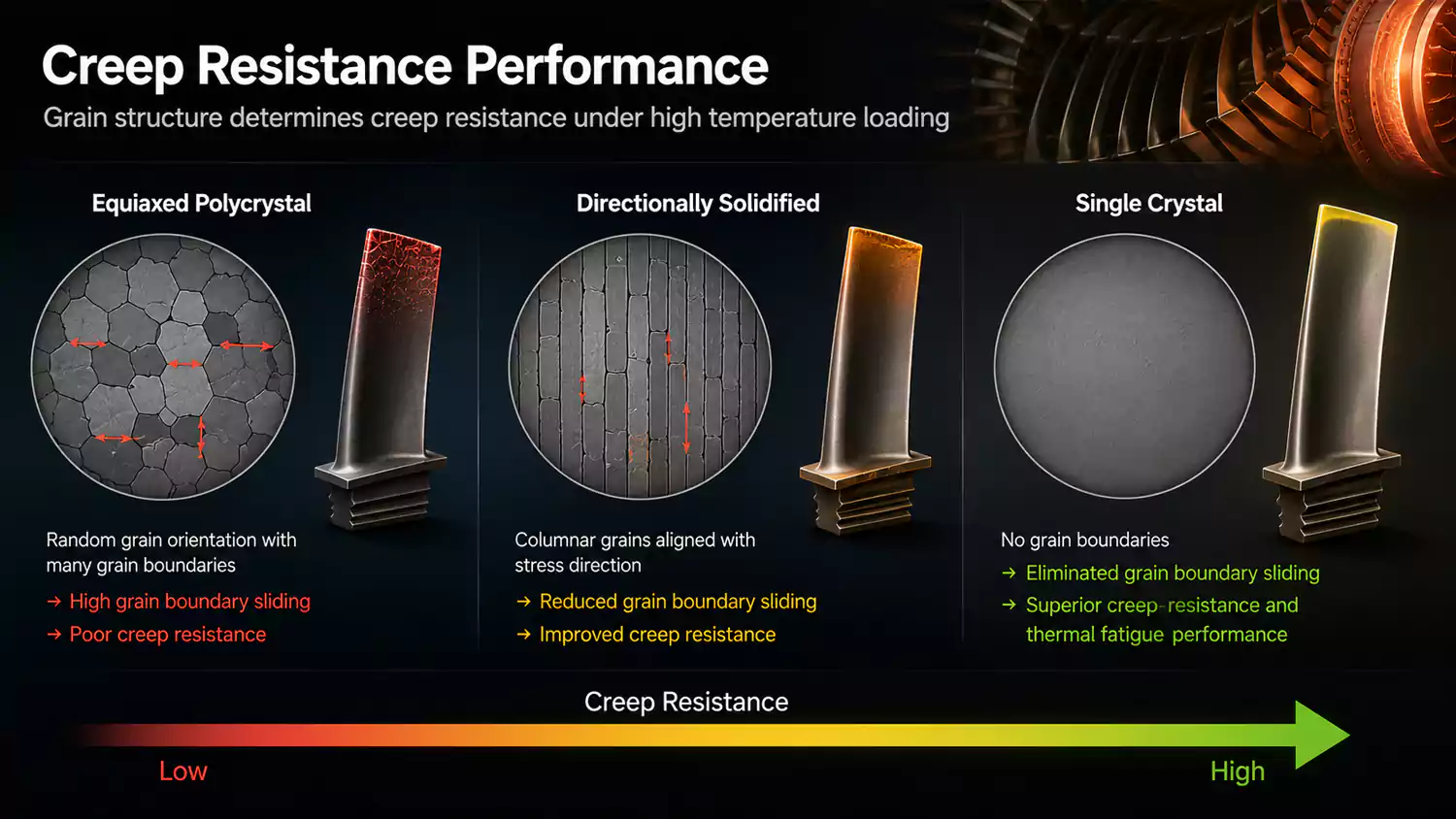
Grain structure affects turbine blade life by controlling grain boundary sliding. Directional solidification significantly reduces grain boundary movement, while single crystal structures remove grain boundaries completely, resulting in the highest creep resistance and thermal fatigue performance.
The Hidden Role of Grain Boundary Sliding
When turbine blades operate at high temperatures for thousands of hours, stress causes grains to deform slowly.
The movement is usually concentrated along grain boundaries.
This is why grain orientation becomes so important.
Performance Comparison
| Structure | Relative Creep Life2 |
|---|---|
| Equiaxed | 1.0x |
| Directional Solidification | 2.0–4.0x |
| Single Crystal | 5.0–10.0x |
Industry Insight
One lesson I learned from senior foundry experts with more than 20 years of turbine casting experience is that many applications do not require full single crystal performance.
In fact, properly aligned DS structures often achieve performance levels that approach single crystal behavior in real-world service conditions. This creates an opportunity to achieve near-DS performance at a much lower cost than SX production.
For sourcing managers, this often becomes the most practical optimization strategy.
How Investment Casting Controls Turbine Blade Grain Structure
Producing the desired grain structure requires more than alloy selection. It depends heavily on precise control during solidification.
Investment casting controls turbine blade grain structure through carefully managed thermal gradients, mold design, cooling rates, and crystal growth techniques. These process controls determine whether the final blade develops an equiaxed, directional solidification, or single crystal structure.
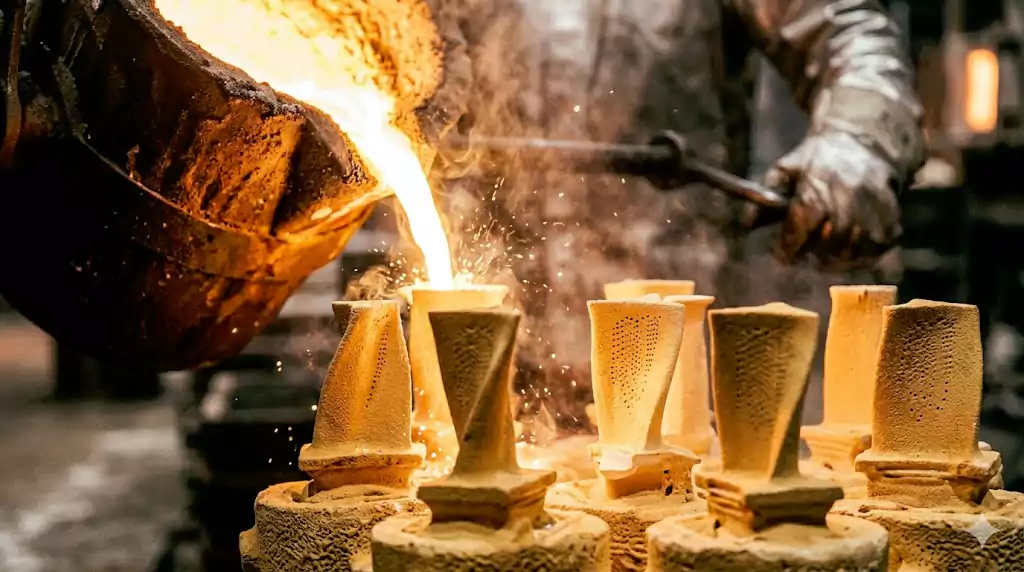
Many of the advanced methods used in modern investment casting for turbine blades are specifically designed to control crystal growth and maximize high-temperature performance.
Equiaxed Casting Process
Standard investment casting allows grains to nucleate freely throughout the mold.
This creates random grain orientation.
The process is relatively straightforward and cost-effective.
Directional Solidification Process
DS casting introduces controlled cooling from one direction.
A strong temperature gradient forces grains to grow upward along the blade axis.3
Single Crystal Process
SX production adds a grain selector.
The selector allows only one crystal orientation to continue growing into the blade cavity.
This process requires exceptional thermal control.
Case Study: Industrial Gas Turbine First-Stage Blade
A customer requested improved creep performance while maintaining strict cost targets.
| Parameter | Value |
|---|---|
| Component | First-Stage Turbine Blade |
| Alloy | Nickel-Based Superalloy |
| Blade Length | 132 mm |
| Maximum Operating Temperature | 980°C |
| Operating Stress | 165 MPa |
| Annual Production Volume | 4,500 Pieces |
| Original Structure | Equiaxed |
| Optimized Structure | Directional Solidification |
Results
| Metric | Equiaxed | DS |
|---|---|---|
| Average Creep Life | 8,200 Hours | 24,500 Hours |
| Thermal Fatigue Cycles | 4,800 | 11,700 |
| Scrap Rate | 3.2% | 5.4% |
| Relative Manufacturing Cost | 1.0 | 1.45 |
A foundry specialist with over two decades of turbine casting experience led the process optimization. The team adjusted withdrawal speed, shell thickness, and furnace thermal gradients. The final DS structure delivered nearly three times the creep life while increasing manufacturing cost by less than 50%.
For manufacturers developing custom turbine blade manufacturing programs, this type of optimization often produces the best return on investment.
How to Choose the Right Grain Structure for Your Turbine Blade Application?
Selecting the wrong grain structure can result in either premature failure or unnecessary cost.
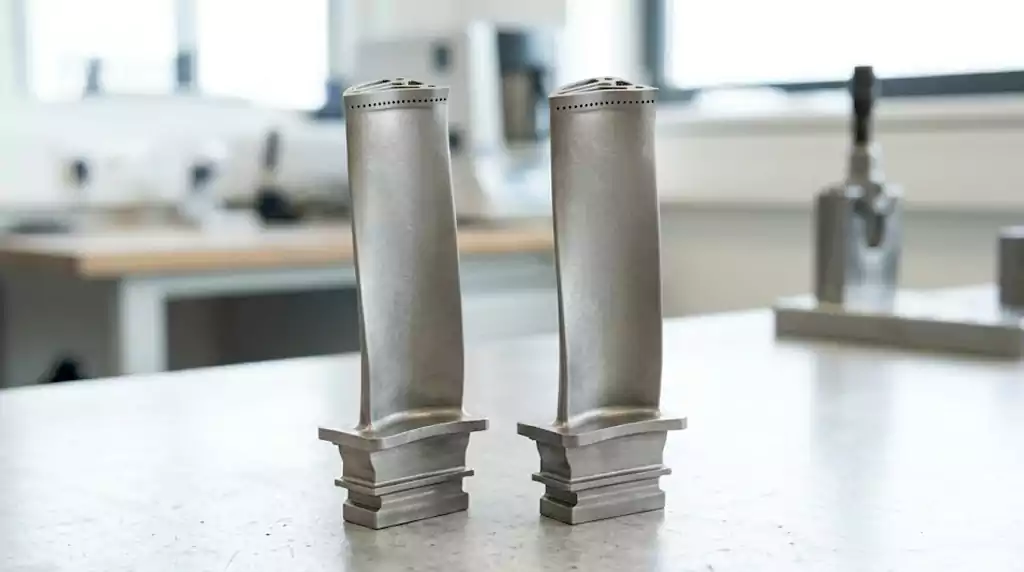
The right turbine blade grain structure depends on operating temperature, stress level, service life targets, and budget. Equiaxed structures are suitable for moderate conditions, DS structures fit most high-performance industrial applications, and SX structures are best for the most extreme environments.
Selection Guidelines
| Application Condition | Recommended Structure |
|---|---|
| Moderate Temperature | Equiaxed |
| High Temperature Industrial Turbine | DS |
| Aircraft Engine Hot Section | SX |
| Cost-Sensitive Production | Equiaxed or DS |
| Maximum Life Requirement | SX |
Questions I Ask Customers
Before recommending a casting route, I usually ask:
- What is the maximum operating temperature?
- What is the expected service life?
- Is creep the primary failure mechanism?
- What certification requirements apply?
- What is the allowable cost target?
The answers often reveal that DS is the most balanced solution. Many users initially assume they need single crystal technology. After reviewing performance requirements, they discover that directional solidification provides the needed reliability with significantly lower manufacturing costs.
Conclusion
Grain structure is one of the most powerful factors influencing turbine blade performance. While single crystal technology delivers the highest capability, many applications achieve outstanding results with directional solidification. By matching grain structure to real operating conditions, manufacturers can improve reliability, extend service life, and control production costs without sacrificing performance.
Footnotes:
-
"Grain boundary sliding - Wikipedia", https://en.wikipedia.org/wiki/Grain_boundary_sliding. A materials-science source should be cited to define grain boundary sliding as deformation caused by relative motion of grains along their boundaries under stress, especially at elevated temperatures, and to explain its role in high-temperature creep. Evidence role: mechanism; source type: paper. Supports: At elevated temperatures and under continuous stress, grain boundaries can weaken and grains can slide relative to one another in a process known as grain boundary sliding.. Scope note: This supports the general mechanism; the severity in a specific casting depends on alloy, grain size, stress, temperature, and service environment. ↩
-
"Anisotropy in Creep Behavior of a Directionally Solidified Ni-Based ...", https://pmc.ncbi.nlm.nih.gov/articles/PMC12072548/. Comparative studies and reviews of nickel-base superalloy turbine-blade materials report that directional solidification improves creep resistance by reducing transverse grain boundaries and that single-crystal alloys improve it further by eliminating grain boundaries; this supports the ranking in the table, while the exact multipliers are alloy-, stress-, temperature-, and test-dependent. Evidence role: statistic; source type: paper. Supports: Directional solidification and single-crystal casting provide substantially longer creep life than equiaxed structures, with single-crystal structures generally offering the highest creep resistance.. Scope note: The source may support the relative ordering more directly than the precise 2.0–4.0x and 5.0–10.0x ranges, which can vary substantially by test condition and alloy generation. ↩
-
"Grain structure development in directional solidification of nickel ...", https://www.academia.edu/104219338/Grain_structure_development_in_directional_solidification_of_nickel_base_superalloys. Materials-processing references describe directional solidification as using an imposed thermal gradient and controlled withdrawal to promote columnar grain growth along the heat-flow direction, which supports the statement about upward grain growth in turbine-blade molds. Evidence role: mechanism; source type: education. Supports: In directional solidification casting, a strong temperature gradient promotes grains to grow along the blade axis.. Scope note: The source would explain the general solidification mechanism rather than verify the exact furnace conditions used in this article. ↩