
A flywheel can look like a simple round metal part, but poor casting integrity or machining can create vibration, imbalance, and early failure.
I treat a custom engine flywheel as a precision powertrain component that depends on both sound casting and accurate machining. In my experience, about 70% of its durability comes from casting integrity and 30% from precision machining.
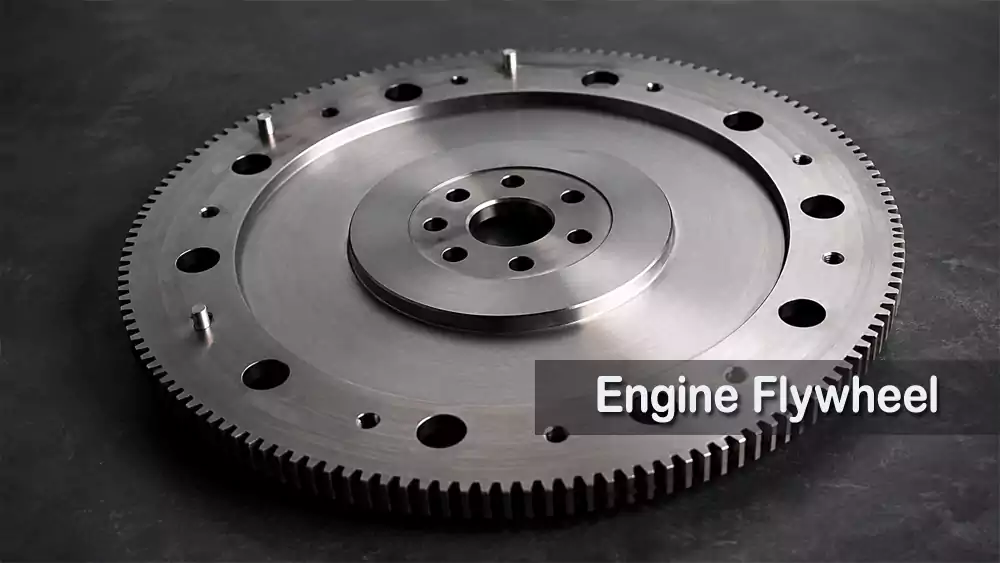
I have worked with many metal components where the final machining gets most of the attention. I do not think a flywheel should be handled that way. The machining can be excellent, but hidden casting defects can still weaken the part. That is why I start with the material and casting process, then control the machining and inspection as one complete process.
What Is a Flywheel and Why Is It Important?
A flywheel may look simple from the outside, but its job puts it under repeated mechanical loads. If the material, geometry, or balance is wrong, the problem can show up as vibration, noise, or premature wear.
I see an engine flywheel as a rotating mechanical component that stores rotational energy, helps smooth engine speed, and provides an accurate interface between the engine and drivetrain. Its strength, balance, and dimensional accuracy all affect engine reliability.
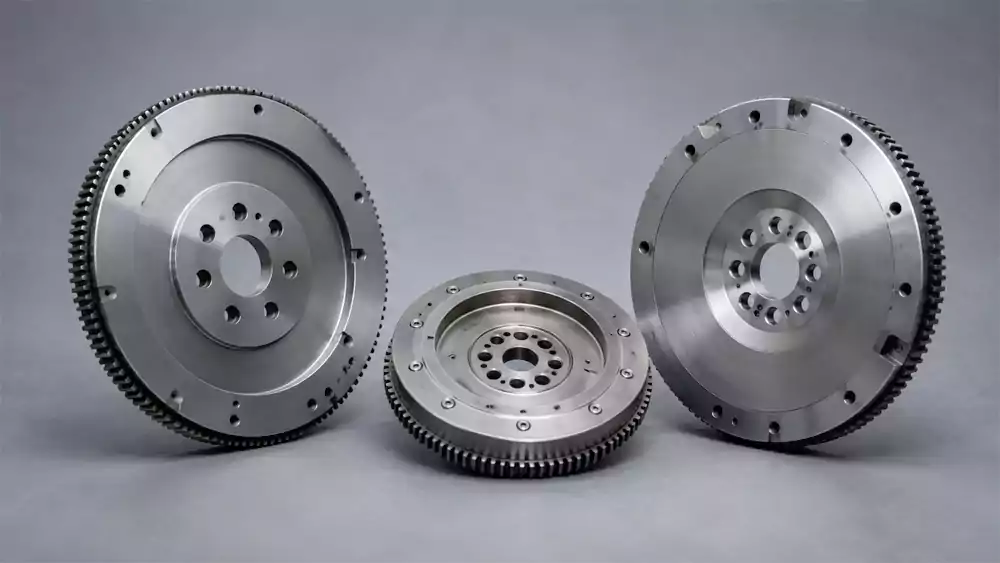
The first point I check is the basic function of the flywheel. An engine does not produce perfectly smooth rotational torque. The combustion process creates pulses. The flywheel uses its mass and rotational inertia to help smooth these changes and maintain more stable rotation.1
The flywheel also provides important mounting and locating features. Depending on the engine and drivetrain design, these features can include crankshaft mounting holes, clutch contact surfaces, locating bores, and other machined interfaces.
Why Casting Integrity Matters
I pay close attention to the casting stage because a flywheel can contain defects that are not visible after machining. Porosity, inclusions, shrinkage, and other internal problems can reduce the effective strength of the component.
This is why I use a simple rule when evaluating a custom flywheel: the machining cannot repair a fundamentally bad casting.
For demanding custom engine flywheels, I focus on:
| Quality Factor | What I Control |
|---|---|
| Casting integrity | Porosity, inclusions, shrinkage, and internal defects |
| Material | Correct alloy and material certification |
| Geometry | Wall thickness, ribs, and overall profile |
| Balance | Mass distribution around the rotational axis |
| Mounting features | Hole position, diameter, and locating geometry |
| Machined surfaces | Flatness, runout, and surface finish |
I also use X-ray inspection when the application requires internal quality verification. In my production approach, X-ray checks have shown zero defects over 0.5 mm. I use this type of inspection because visual inspection alone cannot tell me what is happening inside a dense metal component.
Engine Flywheel vs. Flexplate: What Is the Difference?
I often see flywheels and flexplates treated as interchangeable parts because both connect the engine to the drivetrain. They are not the same component, and their different structures reflect different transmission systems.
An engine flywheel is typically a thicker, rigid rotating disc used with a manual transmission and clutch, while a flexplate is a lighter component that connects an engine to an automatic transmission torque converter. Their different designs reflect different drivetrain requirements.
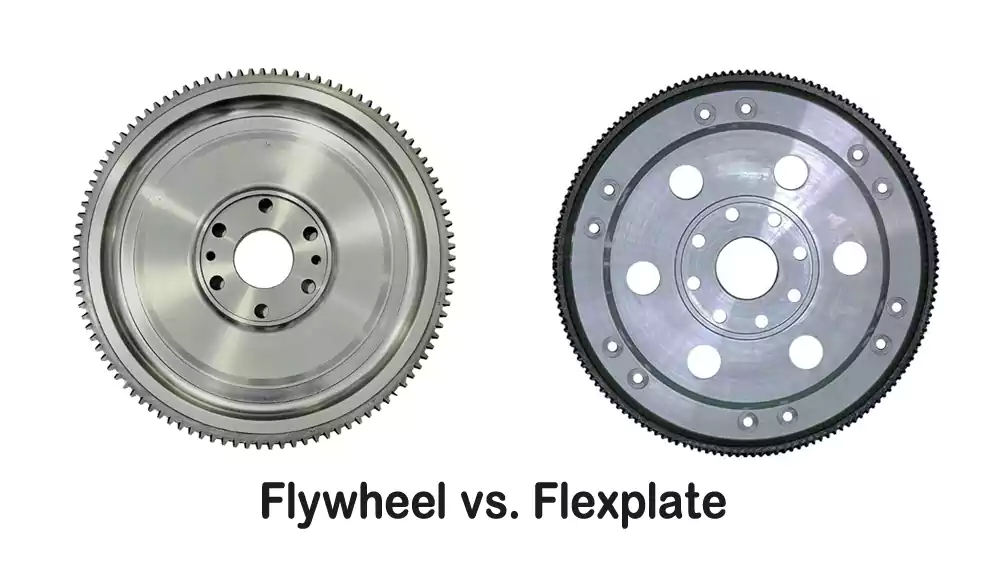
The biggest difference I look at is the transmission interface. A conventional flywheel works with a clutch system. It therefore needs a suitable friction surface and enough mass to perform its intended rotational function.
A flexplate has a different job. It connects the crankshaft to the torque converter and usually uses a thinner stamped or formed construction. It does not need to provide the same clutch friction surface as a traditional flywheel.
Why the Difference Matters for Custom Manufacturing
When I receive a custom drawing, I do not start by asking only for the outside diameter. I first identify how the component will work in the powertrain.
| Feature | Engine Flywheel | Flexplate |
|---|---|---|
| Typical transmission | Manual | Automatic |
| Construction | Thicker and more rigid | Thin and flexible |
| Main interface | Clutch | Torque converter |
| Friction surface | Usually required | Usually not required |
| Rotational mass | More significant | Generally lower |
| Machining requirements | Often extensive | Depends on design |
The mounting pattern is also critical. A flywheel can have the correct outside diameter and still fail to fit because the crankshaft bolt pattern or locating geometry is incorrect.
I pay particular attention to concentricity. The center of the mounting features needs to remain aligned with the rotational axis. A small positional error can become a much larger problem once the component rotates at high speed.
I also consider the relationship between the machined surfaces. The crankshaft mounting face, locating bore, clutch surface, and bolt holes must work together. I do not treat these dimensions as isolated numbers.
How Are Custom Engine Flywheels Manufactured?
I manufacture a custom engine flywheel by controlling the process from casting through heat treatment, machining, balancing, and final inspection. I do not treat CNC machining as a separate activity from casting because the final performance depends on both.
I normally manufacture a custom engine flywheel through investment casting, controlled metal casting, inspection, heat treatment when specified, precision CNC machining, hole machining, balancing, and final dimensional inspection.
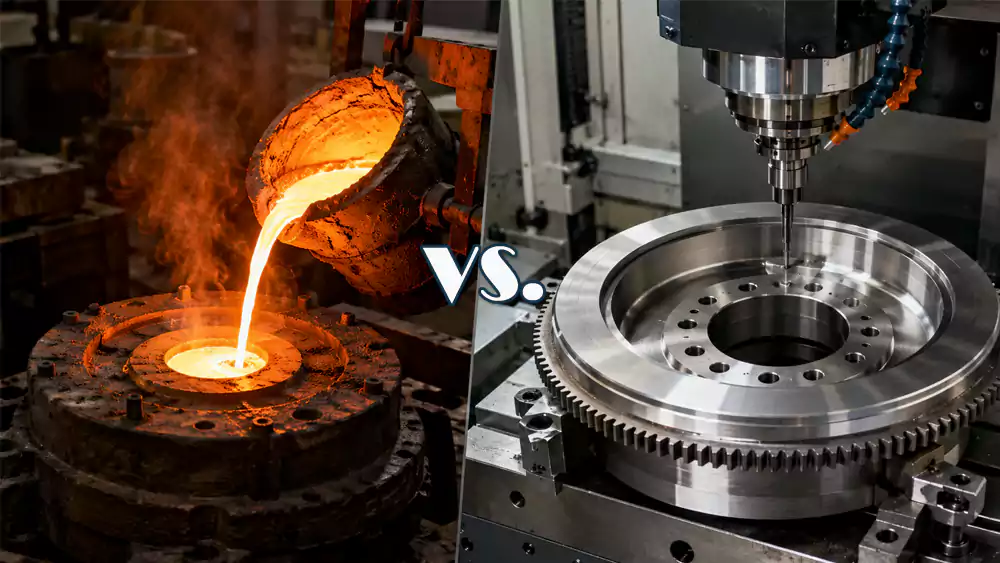
I first review the drawing and identify the functional surfaces. I mark the mounting face, locating bore, bolt holes, friction surfaces, and other critical features. This tells me which dimensions need the tightest process control.
Casting the Near-Net-Shape Part
For a complex custom design, I use investment casting when the geometry and production requirements make it suitable. The process can reduce the amount of material that needs to be removed during machining.
I pay special attention to metal flow, wall thickness, solidification, and potential shrinkage areas. The casting design needs to support sound internal structure before I think about final dimensions.
My target is to keep casting porosity under 1% for the applicable production requirements. I also use X-ray inspection to check internal integrity when specified.
Precision CNC Machining
After the casting has passed the required inspection, I move to machining.
I use CNC machining to establish the functional dimensions that casting alone cannot reliably achieve. This includes mounting holes, locating bores, flat surfaces, and other critical interfaces.
For custom flywheels, I can use multi-axis machining where the geometry requires it. In particular, I use 5-axis machining for complex hole patterns and features where maintaining the correct spatial relationship is important.
For critical holes, my target can be within ±0.015 mm, depending on the drawing and feature requirements.
I do not try to apply the same tolerance to every dimension. That usually adds cost without improving performance. I focus tight tolerances on the features that actually control assembly, alignment, and rotation.
Case Study: Custom Engine Flywheel
I recently approached a custom flywheel project by separating the casting requirements from the machining requirements. This made the inspection plan much easier to control.
The part required a stable cast structure first, followed by precision machining of the mounting and locating features.
| Parameter | Production Target |
|---|---|
| Manufacturing method | Investment casting + CNC machining |
| Casting porosity target | < 1% |
| Internal inspection | X-ray inspection |
| X-ray defect threshold | No defects > 0.5 mm |
| Critical hole machining | 5-axis CNC |
| Critical hole tolerance | ±0.015 mm |
| Main process priority | Casting integrity before machining2 |
| Final focus | Alignment, dimensional accuracy, and rotational stability |
I learned early in my foundry career that machining a defective casting only makes the defect harder to see. The machinist may achieve a beautiful surface while the internal structure remains unacceptable.
That is why I prefer to stop the problem at the casting stage. I use X-ray inspection before the part moves too far into the machining process. This reduces the risk of spending machining time on a casting that should never enter final production.
I also inspect the machined mounting features against the drawing. I check hole diameter, position, locating geometry, and the relationship between the main functional surfaces.
This approach reflects how I think about flywheel manufacturing. I do not see the casting and machining departments as two separate quality systems. They are two stages of the same component. For broader applications, I use the same approach when developing custom engine powertrain parts, where casting integrity and machining accuracy must work together.
How Do You Ensure Custom Engine Flywheel Quality?
I ensure custom engine flywheel quality by controlling casting integrity, material certification, machining accuracy, dimensional inspection, and rotational requirements as one system. I focus most heavily on the features that affect assembly and engine operation.
I ensure custom engine flywheel quality by verifying the material and casting integrity first, then controlling critical machining dimensions, hole positions, alignment, surface condition, and final inspection against the drawing.
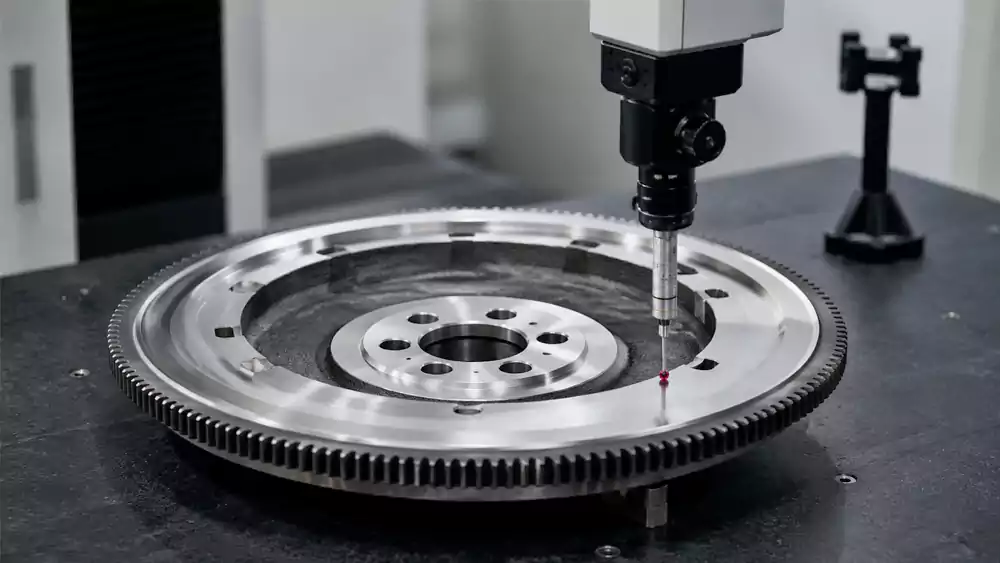
I start with incoming material and casting control. The material must match the specified grade, and the casting needs to meet the required internal quality standard.
Then I move to dimensional control. I do not rely on a single final measurement. I inspect the critical features that determine whether the flywheel will assemble correctly and rotate properly.
The Four Checks I Prioritize
1. Casting Integrity
I use visual inspection for surface conditions and X-ray inspection for internal conditions. This is important because internal defects cannot always be detected from the outside.
2. Dimensional Accuracy
I measure the critical dimensions after machining. Hole diameter and position are especially important because they directly affect assembly.
3. Alignment and Rotational Geometry
I pay attention to the relationship between the locating bore, mounting face, and bolt pattern. These features must remain properly aligned around the rotational axis.
4. Final Surface Condition
I check machined surfaces for the required finish, burrs, damage, and other conditions that could affect assembly.
I also believe that quality control should begin before the first part is finished. If a process is producing the wrong geometry, finding the problem only at final inspection is too late.
For that reason, I use process checks during production. I want to know whether the casting process is stable and whether the machining process is holding its dimensions.
| Inspection Stage | Main Purpose |
|---|---|
| Material verification | Confirm specified material |
| Casting inspection | Check surface and casting integrity |
| X-ray inspection | Detect internal defects |
| CNC in-process inspection | Control critical dimensions |
| Final dimensional inspection | Confirm drawing requirements |
| Final visual inspection | Check surface and workmanship |
When I evaluate a complete engine powertrain component, I use the same principle: custom engine powertrain parts need a controlled manufacturing process from the initial material through the final machined feature.
My main principle is simple: I want to keep defects inside the factory instead of allowing them to reach the customer.
Conclusion
I build custom engine flywheels around sound casting, controlled machining, accurate alignment, and disciplined inspection because reliable rotation starts with the quality of the metal itself. If you are developing a custom flywheel or other engine powertrain component, I can help you evaluate the material, casting process, machining requirements, and quality controls from the start.
-
"Numerical analysis of a flywheel energy storage system for low ...", https://www.sciencedirect.com/science/article/pii/S2352152X23002050. Rotating inertial energy storage in a flywheel reduces the amplitude of speed (angular velocity) variations resulting from periodic torque disturbances, as described by standard rigid-body rotational dynamics (torque–angular acceleration relationship and energy/inertia buffering). The claim is consistent with textbook-level mechanism explanations but should be contextualized to specific operating conditions (torque ripple frequency, inertia ratio). Evidence role: mechanism; source type: education. Supports: The flywheel uses its mass and rotational inertia to help smooth combustion torque pulses and maintain more stable rotation.. Scope note: Support is likely contextual (depends on inertia ratio, torque ripple characteristics, and system stiffness/damping) rather than a direct universal quantitative proof. ↩
-
"Non-Destructive Testing", https://www.sfsa.org/subject-areas/education/information-for-casting-designers/non-destructive-testing/. Quality management in metal casting emphasizes defect prevention and early inspection (e.g., to detect internal porosity and other defects) because downstream machining cannot reliably remove or “fix” internal casting defects and may mask them by improving only the surface. Evidence role: general_support; source type: research. Supports: Casting integrity before machining. Scope note: Support is expected to come from foundry/casting quality literature describing why internal defects must be controlled prior to machining, rather than relying on machining to correct them. ↩