
Choosing the wrong stainless steel grade can increase production cost, shorten part life, and create machining or welding problems that appear only after mass production starts.
Stainless steel grades differ in corrosion resistance, strength, machinability, weldability, and casting performance. The best material choice depends on your working environment, production method, mechanical requirements, and total manufacturing cost.
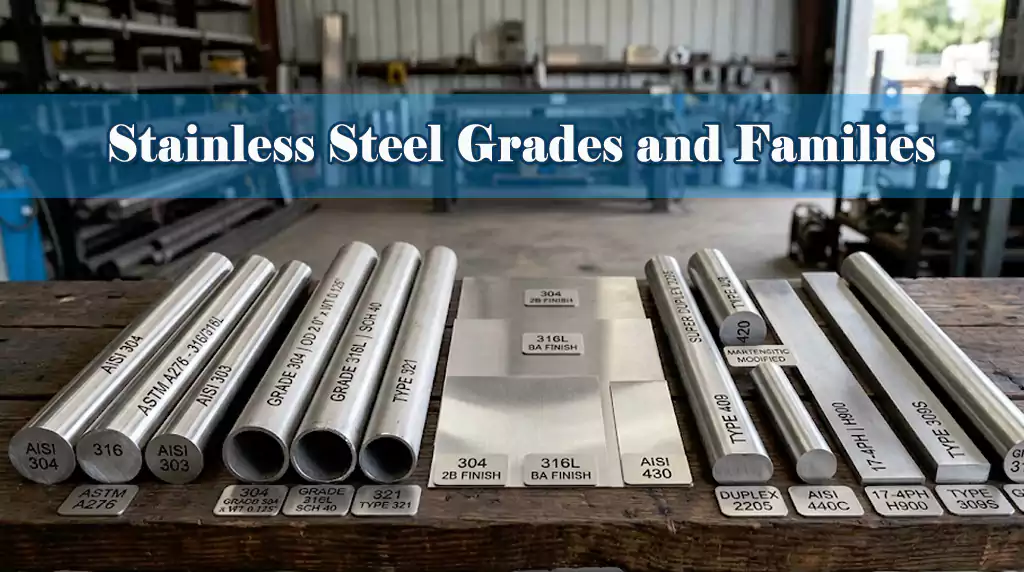
I have worked with stainless steel casting and machining projects for years. I still see engineers and sourcing managers struggle with material selection. Some focus only on corrosion resistance. Others only care about price. In real manufacturing, the best solution usually comes from balancing performance, process efficiency, and long-term production cost.
What Are the Main Families of Stainless Steel?
Many buyers know grades like 304 or 316. Fewer understand how stainless steel families actually differ. That often leads to expensive material mistakes during production.
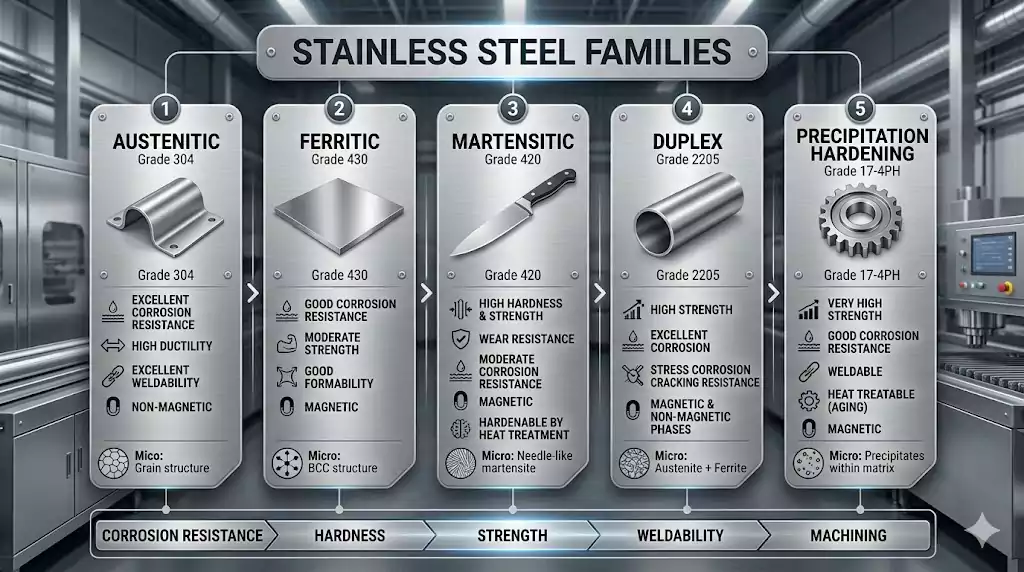
The five main stainless steel families are austenitic, ferritic, martensitic, duplex, and precipitation hardening stainless steels. Each family offers different levels of corrosion resistance, hardness, strength, weldability, and machining performance.
Austenitic Stainless Steel
Austenitic stainless steel is the most widely used family. Grades like 304 and 3161 belong to this category. These materials contain high chromium and nickel content. That gives them excellent corrosion resistance and strong weldability.
I often recommend austenitic grades for food equipment, medical parts, pumps, and marine hardware. They are also highly suitable for stainless steel casting because they flow well during pouring and maintain strong toughness after solidification.
Common grades include:
| Grade | Main Feature | Typical Application |
|---|---|---|
| 304 | General corrosion resistance | Kitchen equipment |
| 316 | Better chloride resistance | Marine components |
| CF8 | Cast version of 304 | Valve bodies |
| CF8M | Cast version of 316 | Pump housings |
Ferritic Stainless Steel
Ferritic grades contain chromium but very little nickel. They offer decent corrosion resistance at a lower cost. However, they are less ductile than austenitic grades.
I usually see ferritic stainless steel used in automotive exhaust systems and decorative hardware. These grades are magnetic and often easier to machine than austenitic grades.
Common grades include 430 and 4092.
Martensitic Stainless Steel
Martensitic stainless steel focuses on hardness and wear resistance. These grades can be heat treated for higher strength.
410 and 4203 are common examples. I often see them used for blades, shafts, valve trim, and industrial tools. Their machining performance is good after heat treatment, but corrosion resistance is lower compared to 304 or 316.
Duplex Stainless Steel
Duplex stainless steel combines austenitic and ferritic structures. It delivers high strength and excellent resistance to chloride stress corrosion cracking.
2205 is one of the most common duplex grades. I recommend it for offshore equipment, chemical processing systems, and high-pressure industrial parts.
These materials can reduce wall thickness because of their higher strength. That helps lower both weight and raw material cost.
Precipitation Hardening Stainless Steel
Precipitation hardening stainless steel provides very high strength while maintaining good corrosion resistance.
17-4 PH is the most widely used grade in this family. It is commonly used in aerospace, energy, and precision machinery industries. Many engineers also compare different precipitation hardening stainless steel grades when balancing strength and corrosion resistance.
I often recommend this material when customers need both mechanical strength and dimensional stability after heat treatment.
Which Stainless Steel Grades Are Most Common in Casting and Machining?
Some stainless steel grades cast beautifully but machine poorly. Others machine well but become difficult to weld or polish. Selecting the wrong grade can increase both scrap rate and machining cost.
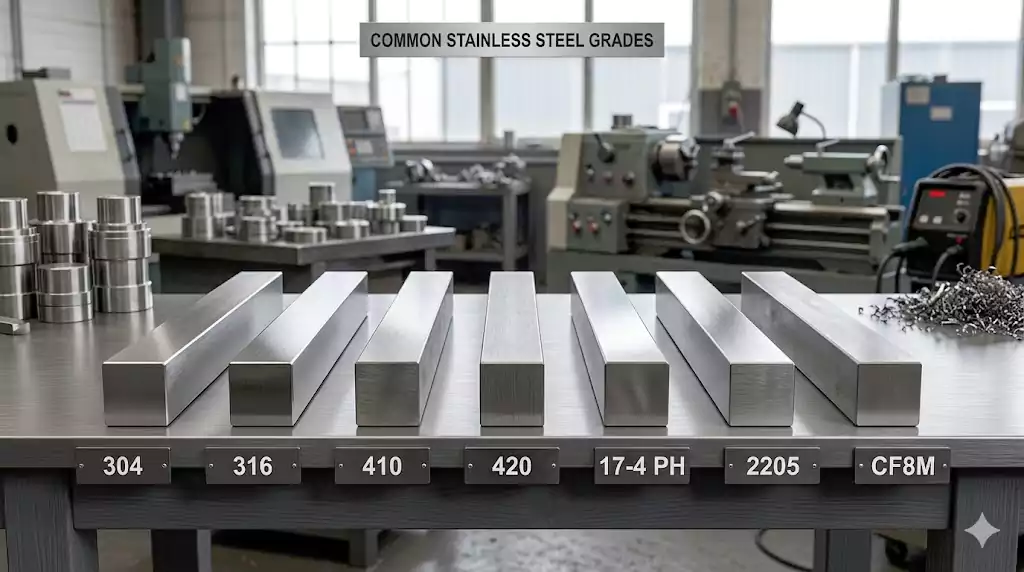
The most common stainless steel grades for casting and machining include 304, 316, 410, 420, 17-4 PH, 2205, CF8, and CF8M. Each grade offers different advantages in corrosion resistance, strength, machinability, weldability, and casting suitability.
Stainless Steel Grade Comparison Table
This comparison structure is the same format I often use during supplier evaluations and technical discussions with sourcing managers.
| Grade | Corrosion Resistance | Strength | Machinability | Weldability | Casting Suitability |
|---|---|---|---|---|---|
| 304 | Excellent | Medium | Fair | Excellent | Excellent |
| 316 | Superior | Medium | Fair | Excellent | Excellent |
| 410 | Moderate | High | Good | Moderate | Good |
| 420 | Moderate | Very High | Good | Limited | Moderate |
| 17-4 PH | Good | Very High | Good | Good | Good |
| 2205 | Excellent | Very High | Moderate | Moderate | Moderate |
| CF8 | Excellent | Medium | Fair | Excellent | Excellent |
| CF8M | Superior | Medium | Fair | Excellent | Excellent |
304 Stainless Steel
304 is one of the most versatile stainless steel grades available today. It balances corrosion resistance, formability, weldability, and cost very well.
I usually recommend 304 for general industrial parts, food equipment, and architectural hardware. It is also one of the easiest grades to source globally.
316 Stainless Steel
316 contains molybdenum. That significantly improves resistance to chlorides and harsh chemicals.
I often use 316 for marine applications, pharmaceutical systems, and chemical processing equipment. Engineers who want to compare which stainless steel is best for casting often place 316 near the top for corrosion resistance.
The price is higher than 304, but the longer service life often justifies the extra material cost.
410 and 420 Stainless Steel
410 and 420 are martensitic stainless steel grades. They provide better hardness and wear resistance compared to austenitic grades.
These materials work well for valve components, shafts, industrial tools, and wear-resistant parts. However, corrosion resistance remains lower than 304 or 316.
17-4 PH Stainless Steel
17-4 PH combines very high strength with good corrosion resistance.
I have used this material for aerospace brackets, precision gears, and oilfield equipment. Its heat treatment flexibility makes it highly attractive for demanding engineering applications.
2205 Duplex Stainless Steel
2205 offers almost double the yield strength of 304 stainless steel.
I often recommend this material when customers want lighter components without sacrificing strength or corrosion resistance.
CF8 and CF8M
CF8 and CF8M are cast stainless steel grades equivalent to 304 and 316.
These materials are extremely common in stainless steel investment casting because they provide stable filling performance, good dimensional accuracy, and reliable corrosion resistance.
How Do You Choose the Right Stainless Steel Grade?
Many engineers select the highest-grade material just to avoid risk. That often increases production cost without improving actual product performance.
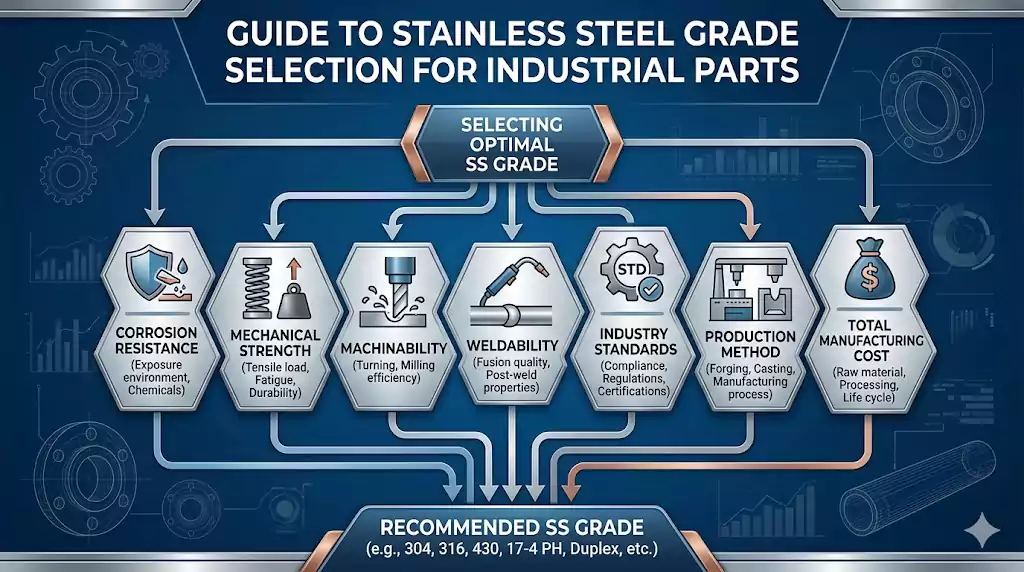
The best stainless steel grade depends on corrosion resistance, mechanical strength, machinability, weldability, industry standards, production method, and total manufacturing cost.
For Corrosion Resistance
I usually recommend:
- 316 for marine and chemical exposure
- 2205 for aggressive chloride environments
- 304 for standard industrial conditions
For High Strength
If strength is the priority, I often suggest:
- 17-4 PH
- 420 stainless steel
- 2205 duplex stainless steel
These materials allow thinner wall sections while maintaining structural integrity.
For Machinability
Machining cost affects total production cost more than many buyers expect.
410 and 420 machine better than 304 or 316. That can reduce CNC cycle time and tooling wear significantly.
For Welding
304 and 316 remain the easiest stainless steel grades to weld. Duplex materials require tighter welding control and more experienced operators.
For Food or Medical Applications
304 and 316 remain the most common choices because they provide clean surface finishes and strong corrosion resistance.
For Cost Efficiency
In many industrial projects, 304 delivers the best balance between performance and total cost.
I always tell customers not to chase the highest specification unless the application truly requires it.
Stainless Steel Casting vs Machining: Which Process Is Better?
Many metal parts become expensive because they are fully machined from solid bar stock. Others fail because the casting process was not optimized correctly from the beginning.
Investment casting reduces material waste and machining time by producing near-net-shape components, while CNC machining delivers tighter tolerances, better surface finish, and higher dimensional precision.
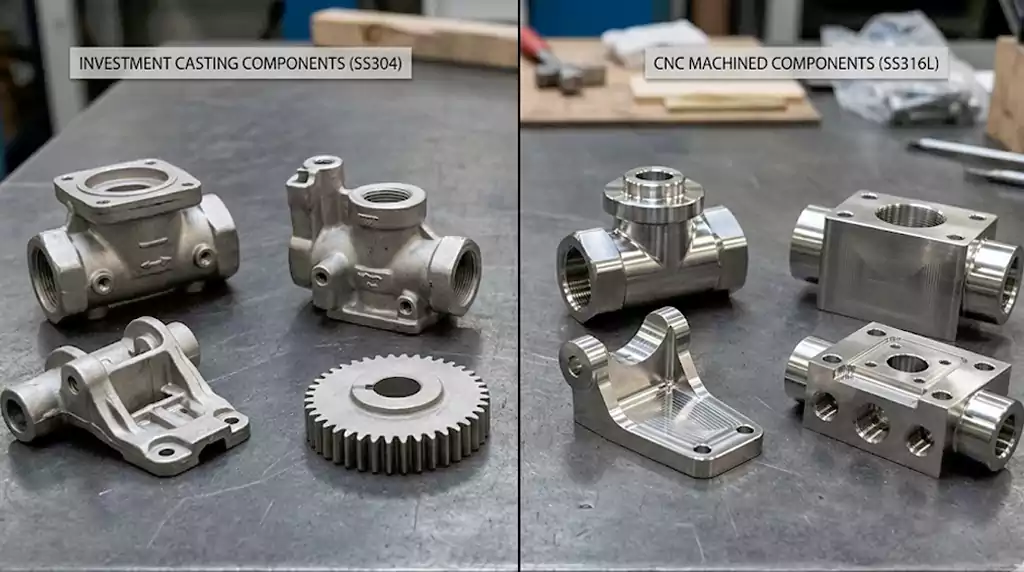
Investment Casting Advantages
Investment casting works extremely well for complex stainless steel components.
Key advantages include:
- Near-net-shape production
- Lower material waste
- Reduced machining time
- Complex geometry capability
- Better production efficiency for medium and high volumes
CNC Machining Advantages
CNC machining is ideal for:
- Tight tolerances
- Precision holes and threads
- Superior surface finish
- Prototype flexibility
In many projects, the best solution combines both processes.
At Allied Metal, I often help customers begin with investment casting and finish critical dimensions through precision CNC machining. That approach balances quality, lead time, and total production cost without unnecessary secondary operations.
Real Case Study: Valve Control Arm for Energy Equipment
One project involved a custom stainless steel valve control arm used in offshore energy equipment.
| Parameter | Value |
|---|---|
| Material | CF8M Stainless Steel |
| Process | Investment Casting + CNC Machining |
| Weight | 1.85 kg |
| Tolerance | ±0.05 mm critical dimensions |
| Surface Finish | Ra 1.6 μm |
| Annual Volume | 18,000 pcs |
| Operating Environment | Saltwater exposure |
| Heat Treatment | Solution Annealed |
A senior foundry engineer with more than 20 years of casting experience reviewed the gating system design. He reduced shrinkage defects by changing the runner layout and optimizing pouring temperature from 1590°C to 1565°C.
That adjustment improved yield by 11% and reduced machining stock allowance by 0.8 mm.
The customer lowered total production cost by nearly 14% after switching from fully machined billet production to near-net-shape investment casting.
How Do You Choose a Reliable Stainless Steel Casting Manufacturer?
Many suppliers can produce a sample successfully. Far fewer can maintain stable quality during full-scale production.
A reliable stainless steel casting manufacturer should provide material traceability, strict quality control, machining capability, engineering support, export experience, and stable OEM production capacity.
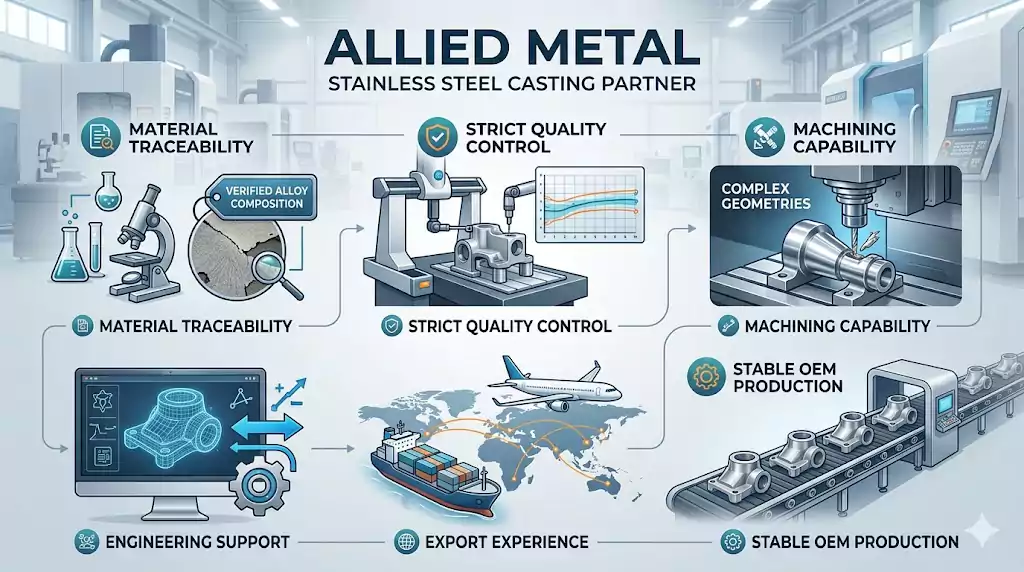
Material Traceability
I always recommend checking whether suppliers can provide:
- Mill test certificates
- Heat number traceability
- PMI testing reports
This becomes especially important in aerospace, medical, and energy industries.
Quality Control
A professional foundry should support:
- Dimensional inspection
- X-ray testing
- Dye penetrant inspection
- Mechanical property testing
Machining Capability
Integrated machining support simplifies communication and shortens lead time.
That becomes very important for tight tolerance stainless steel components.
Engineering Support
Strong engineering teams help optimize:
- Wall thickness
- Draft angle
- Machining allowance
- Casting feasibility
This can significantly reduce production risk later.
Export Experience
International projects require clear documentation, stable packaging, and responsive communication.
I often see technical misunderstandings create more delays than manufacturing itself.
Custom OEM Production
A good manufacturing partner should adapt to your drawings, quality standards, and production targets instead of forcing standard solutions.
I always tell customers not to get lost in the huge range of stainless steel grades. The key is finding the right balance between performance, manufacturability, and cost. My goal is always to optimize the casting and machining process while delivering exactly the quality level the application truly requires.
Conclusion
The best stainless steel solution is rarely the most expensive grade. It is the material and manufacturing process that deliver the right balance of corrosion resistance, strength, machinability, production efficiency, and long-term value for your specific application.
-
"Understanding Industrial Grade Stainless Steels - 304, 316, and ...", https://www.valvesonline.com.au/blog/our-blog/understanding-industrial-grade-stainless-steels-304-316-duplex/?srsltid=AfmBOorCmHkFFdhDuopOF9scLtNZHzgdqUUowBVxDzeD51AOObJw1cbJ. An authoritative materials reference should identify AISI/SAE 304 and 316 stainless steels as common austenitic stainless-steel grades, supporting their classification within the austenitic family. Evidence role: definition; source type: institution. Supports: Grades 304 and 316 are austenitic stainless steel grades.. ↩
-
"Comparing 409, 439, and 430 Stainless Steel Sheet Metal", https://www.gardencityironandmetal.com/blog/comparing-409-439-and-430-stainless-steel-sheet-metal/. An industry or standards-based source identifying AISI/Type 430 and Type 409 as ferritic stainless steels would substantiate that these are representative grades within the ferritic stainless-steel family. Evidence role: case_reference; source type: institution. Supports: Common ferritic stainless steel grades include 430 and 409.. Scope note: This support verifies grade classification, but it may not prove that they are the most commonly used ferritic grades unless the source explicitly discusses prevalence. ↩
-
"Comparison of AISI 410 and 420 Steel | PDF | Iron - Scribd", https://www.scribd.com/document/751778657/410-vs-420-vs-415. A materials reference identifying AISI/SAE 410 and 420 as martensitic stainless-steel grades supports their use as representative examples of the martensitic stainless-steel family. Evidence role: definition; source type: education. Supports: 410 and 420 are common examples of martensitic stainless steel.. ↩