
Finding a stainless steel that offers both high strength and corrosion resistance is hard. Many engineers end up compromising on one side or the other.
Precipitation hardening stainless steel combines high strength, corrosion resistance, and dimensional stability through controlled heat treatment, making it ideal for demanding industrial and investment casting applications.
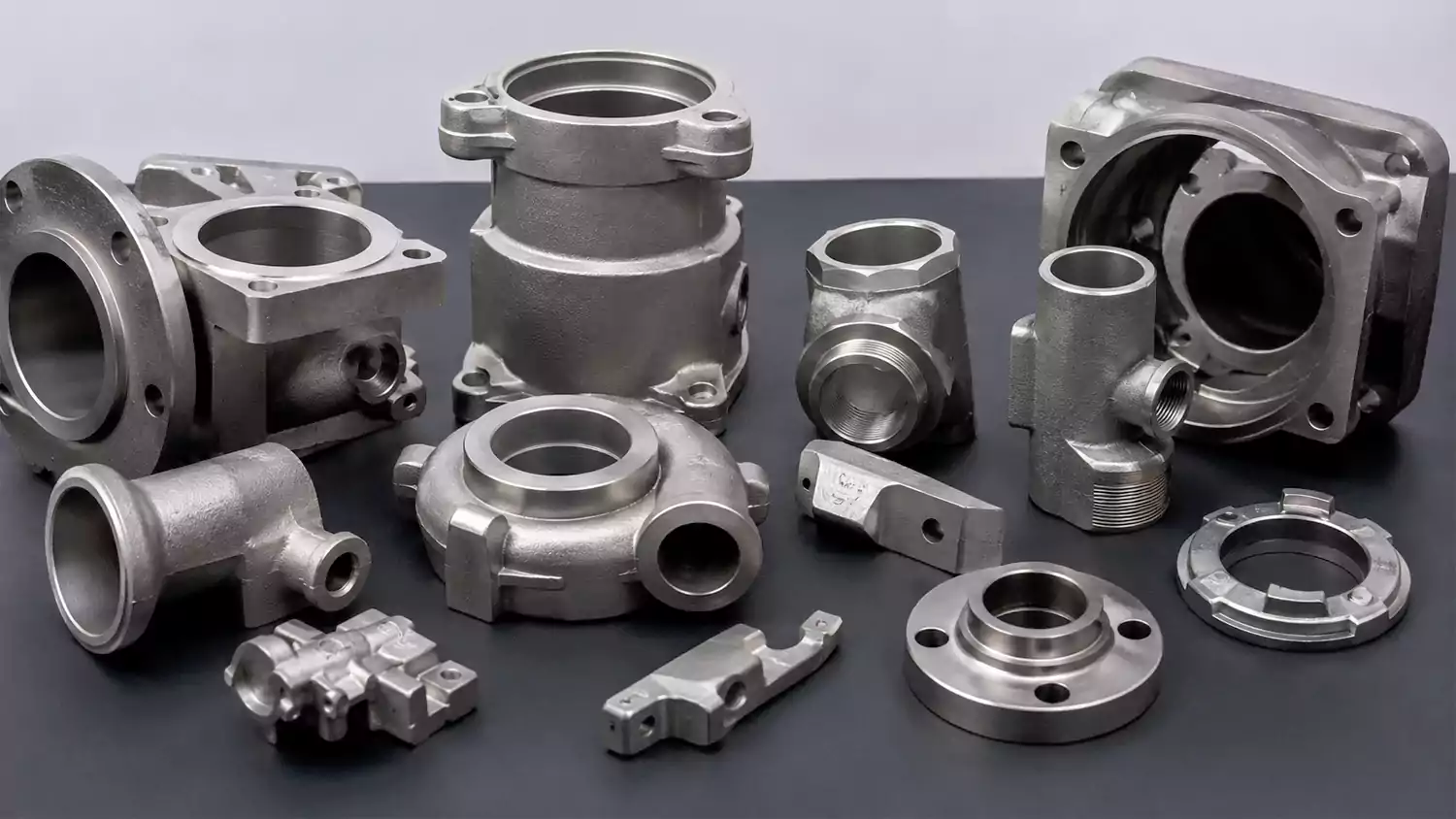
I have worked with many customers who started with 304 or 316 stainless steel and later switched to precipitation hardened stainless steel because their parts failed under high loads or wear conditions. In most cases, the issue was not corrosion. The issue was strength. PH stainless steel fills that gap very well.
What Is Precipitation Hardening Stainless Steel?
Many stainless steels resist corrosion well. But they often lack the strength needed for high-load industrial parts.
Precipitation hardening stainless steel is a heat treatable stainless steel that gains very high strength after solution treatment and aging while still maintaining good corrosion resistance and machinability.
What Is PH Stainless Steel?
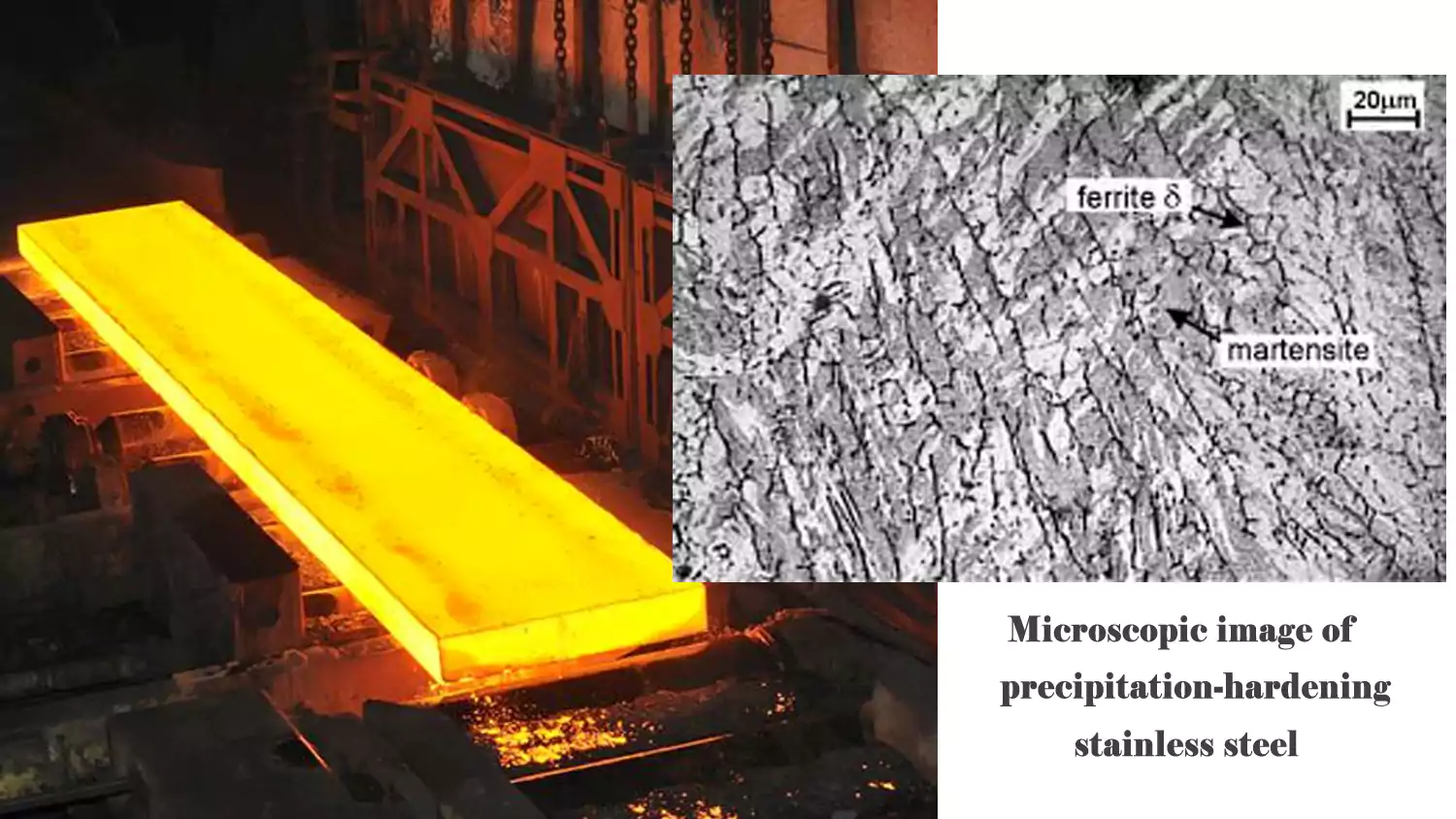
PH stainless steel, also called precipitation hardened stainless steel, is a martensitic or semi-austenitic stainless steel that becomes stronger after heat treatment. Common grades include 17-4PH, 15-5PH, and 13-8Mo.1
Unlike standard stainless steels, PH stainless steel uses a special strengthening process. During manufacturing, alloying elements such as copper, aluminum, niobium, or molybdenum form very small particles inside the metal structure. These particles block dislocation movement and increase hardness and strength.
How Does the Heat Treatment Work?
The process normally has two main steps:
| Process | Purpose | Typical Temperature |
|---|---|---|
| Solution Treatment | Dissolve alloying elements into the matrix | 1020°C - 1060°C |
| Aging Treatment | Form strengthening precipitates | 480°C - 620°C |
During solution treatment, the steel is heated to a high temperature and then rapidly cooled. This creates a supersaturated structure.
After that, the material goes through aging treatment. This step allows fine precipitates to form inside the structure. These precipitates strengthen the metal significantly.
Why Is PH Stainless Steel So Strong?
The main strengthening mechanism comes from precipitation hardening. Tiny particles form inside the metal during aging treatment. These particles prevent internal crystal defects from moving.
This gives PH stainless steel several advantages:
- Very high tensile strength
- High hardness
- Good fatigue resistance
- Better dimensional stability than quenched steels2
I often explain it to customers this way: standard stainless steel relies mainly on chemistry for performance, while PH stainless steel relies on both chemistry and controlled microstructure engineering.
If you want to understand how PH grades compare with other stainless steel casting materials, material selection becomes much easier during early product development.
What Are the Main Grades and Heat Treatment Conditions of PH Stainless Steel?
Choosing the wrong PH grade can create machining problems, welding issues, or unnecessary costs.
17-4PH, 15-5PH, and 13-8Mo are the most common PH stainless steel grades, and their final properties depend heavily on heat treatment conditions such as H900, H1025, and H1150.
Common PH Stainless Steel Grades
| Grade | Main Feature | Typical Industry |
|---|---|---|
| 17-4PH | Balanced strength and corrosion resistance | General industrial |
| 15-5PH | Better toughness and cleanliness | Aerospace |
| 13-8Mo | Highest toughness and strength | High-performance components |
17-4PH Stainless Steel
17-4PH investment casting is one of the most common options in industrial manufacturing. It offers excellent strength, good corrosion resistance, and relatively good machinability.
I see this grade used often for:
- Valve bodies
- Pump components
- Hydraulic parts
- Shafts
- Aerospace fittings
It also works very well for PH stainless steel casting because it responds consistently to heat treatment after casting.
15-5PH Stainless Steel
15-5PH was developed to improve toughness and reduce segregation issues found in 17-4PH.
It performs better in demanding aerospace and pressure applications. Many aerospace buyers prefer it for critical structural parts because the material quality is more uniform.
13-8Mo Stainless Steel
13-8Mo offers very high strength and excellent toughness.3 It is often selected for high-performance aerospace and defense applications.
However, it is more expensive and less common in commercial casting projects.
Heat Treatment Conditions
PH stainless steel properties depend heavily on aging condition.
| Condition | Aging Temperature | Strength Level | Toughness |
|---|---|---|---|
| H900 | ~482°C | Highest | Lower |
| H1025 | ~552°C | Medium-high | Balanced |
| H1150 | ~621°C | Lower | Highest |
Performance Comparison
| Property | 17-4PH | 15-5PH | 13-8Mo |
|---|---|---|---|
| Strength | High | High | Very High |
| Corrosion Resistance | Good | Good | Moderate |
| Machinability | Good | Medium | Medium |
| Toughness | Medium | High | Very High |
| Cost | Medium | Higher | Highest |
In real projects, I often recommend H1025 condition because it balances strength and toughness well. H900 looks attractive on paper because of higher hardness, but some customers later face cracking risks under impact loading.
For engineers comparing casting alloys, this guide on which stainless steel is best for casting can help narrow down the right material faster.
What Are the Advantages and Limitations of PH Stainless Steel?
Many engineers focus only on strength numbers. That can create expensive mistakes during production and long-term service.
PH stainless steel offers very high strength, good corrosion resistance, and strong wear performance, but it also requires controlled heat treatment and usually costs more than standard stainless steels like 304 or 316.
Advantages of PH Stainless Steel
| Advantage | Practical Benefit |
|---|---|
| High Strength | Supports high-load applications |
| Good Corrosion Resistance | Suitable for harsh environments |
| Excellent Wear Resistance | Longer service life |
| Good Machinability | Easier post-processing |
| Dimensional Stability | Lower distortion after heat treatment |
One reason customers choose heat treated stainless steel parts is dimensional stability. Compared with conventional hardened steels, PH stainless steel usually shows less distortion after aging treatment.
This matters a lot for CNC machining stainless steel components with tight tolerances.
Limitations of PH Stainless Steel
| Limitation | Impact |
|---|---|
| Higher Cost Than 304/316 | Increased material budget |
| Heat Treatment Required | More process control needed |
| Welding Challenges | Risk of strength reduction |
The biggest issue I see is improper heat treatment. PH stainless steel only performs well if the foundry and heat treatment supplier control the process carefully.
I have seen low-cost suppliers skip proper aging cycles to reduce production time. The parts looked acceptable visually, but hardness and mechanical properties failed later during testing.
Welding can also become difficult. High-strength PH grades may lose strength around the heat-affected zone if welding procedures are not controlled correctly.
Can PH Stainless Steel Be Investment Cast and Machined?
Some buyers assume PH stainless steel is only suitable for forged or machined products. That is not true.
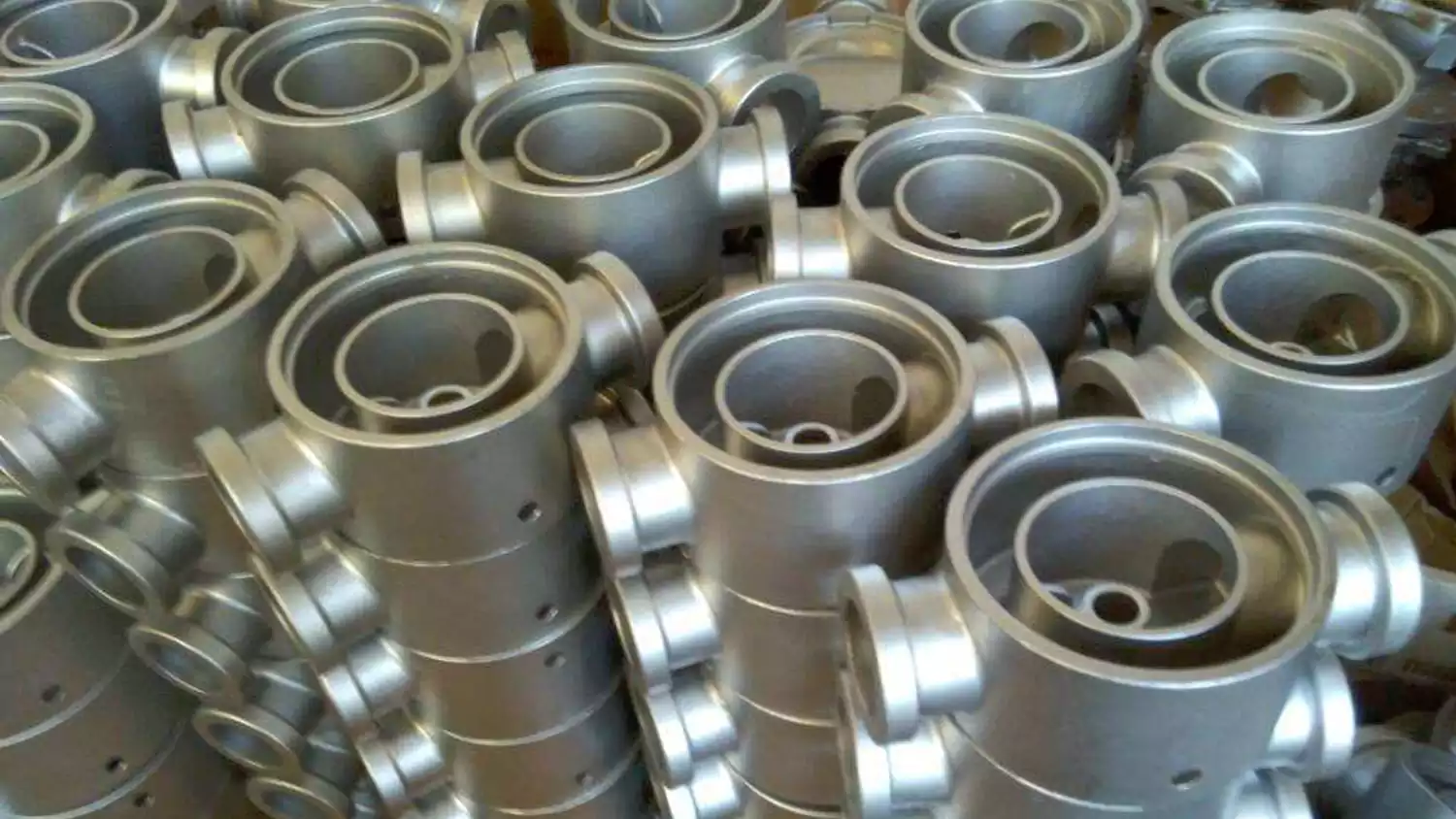
PH stainless steel can be investment cast, heat treated, and CNC machined into complex high-strength parts with tight tolerances, excellent surface finish, and stable mechanical performance.
PH Stainless Steel Casting Capability
PH stainless steel casting works very well for complex geometries and near-net-shape components.
At Allied Metal, we often use custom stainless steel casting to reduce machining costs for parts with:
- Internal flow passages
- Thin walls
- Complex curves
- Integrated mounting features
17-4PH investment casting is especially popular because it combines strong casting behavior with reliable post-heat-treatment properties4.
CNC Machining and Tolerances
After casting and heat treatment, CNC machining stainless steel components allows precise finishing.
Typical capabilities include:
| Feature | Typical Capability |
|---|---|
| Dimensional Tolerance | ±0.05 mm |
| Surface Roughness | Ra 1.6 - 3.2 μm |
| Minimum Wall Thickness | 1.5 mm |
| Maximum Casting Weight | 50+ kg |
Machining is usually easier before final aging treatment because the material hardness is lower.
Heat Treatment After Casting
Most PH stainless steel castings follow this process:
- Investment casting
- Solution treatment
- Rough machining
- Aging treatment
- Finish machining
- Inspection
This sequence helps reduce distortion and maintain dimensional accuracy.
If you are exploring the full stainless steel investment casting process, understanding the order of casting, heat treatment, and machining is very important for achieving stable part quality.
Quality Inspection
For industrial applications, quality control is critical.
Common inspections include:
- Chemical composition analysis
- Tensile testing
- Hardness testing
- Dye penetrant inspection
- X-ray inspection
- Coordinate measuring machine inspection
Case Study: Hydraulic Valve Housing in 17-4PH
One customer from Germany needed a lightweight hydraulic valve housing for industrial equipment. The original forged design required extensive machining and long lead times.
We redesigned the component using PH stainless steel casting.
| Parameter | Value |
|---|---|
| Material | 17-4PH |
| Heat Treatment | H1025 |
| Casting Weight | 4.8 kg |
| Final Weight | 3.9 kg |
| Dimensional Tolerance | ±0.03 mm |
| Surface Finish | Ra 1.6 μm |
| Tensile Strength | 1070 MPa |
| Lead Time Reduction | 28% |
| Machining Cost Reduction | 22% |
One senior foundry engineer on our team, who has more than 25 years of casting experience, pointed out that controlling cooling rate after solution treatment was the key factor for minimizing distortion on this part.
That experience helped us achieve stable production during mass manufacturing.
How to Choose the Right PH Stainless Steel for Your Application?
Using the strongest material is not always the smartest decision. The right grade depends on the environment, loading condition, and production process.
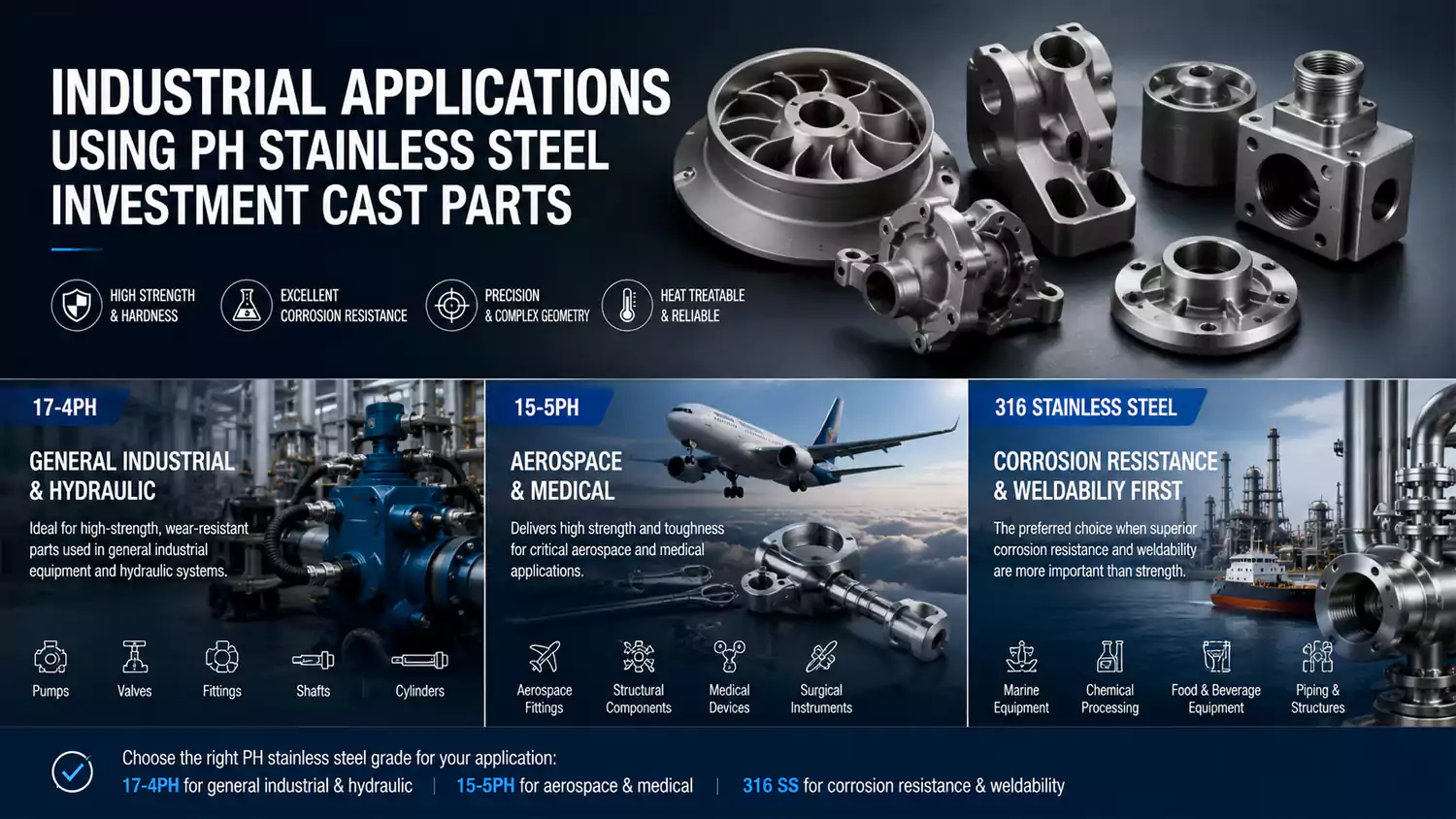
17-4PH is ideal for general industrial and hydraulic parts, 15-5PH works better for aerospace and medical applications, while 316 stainless steel remains a better choice when corrosion resistance and weldability matter more than strength.
When to Choose 17-4PH
17-4PH is usually the best general-purpose option.
Good applications include:
- Automotive components
- Hydraulic systems
- Industrial equipment
- Agricultural machinery
- Pump and valve parts
It offers a strong balance between cost, strength, and corrosion resistance.
When to Choose 15-5PH
15-5PH works better when toughness and reliability matter more.
Common applications include:
- Aerospace fittings
- Medical equipment
- Pressure systems
- Structural aircraft components
When to Choose 13-8Mo
13-8Mo is best for high-performance applications with extreme loading conditions.
Typical uses include:
- Aerospace structural parts
- Defense systems
- High-cycle fatigue applications
When Should You Choose 316 Instead?
Sometimes PH stainless steel is unnecessary.
316 stainless steel may be a better option when:
- Corrosion resistance matters more than strength
- Welding is extensive
- Heat treatment capability is unavailable
- Cost reduction is the priority
I often tell customers this: PH stainless steel solves the problem of wanting high strength and good corrosion resistance at the same time. But it only pays off for people who take heat treatment seriously.
Allied Metal supports custom PH stainless steel investment casting and machining for industrial applications. We help customers optimize material selection, casting design, heat treatment, and CNC finishing for reliable long-term performance.
Conclusion
Precipitation hardening stainless steel gives engineers a practical way to achieve high strength, corrosion resistance, and dimensional stability in one material. When casting, heat treatment, and machining are properly controlled, PH stainless steel becomes an excellent long-term solution for demanding industrial components.
-
"Precipitation hardening stainless steel", https://www.imoa.info/molybdenum-uses/molybdenum-grade-stainless-steels/precipitation-hardening-stainless-steel.php. A materials handbook or educational source listing precipitation-hardening stainless steel grades supports that 17-4PH, 15-5PH, and 13-8Mo are commonly recognized PH stainless steel grades. Evidence role: general_support; source type: education. Supports: 17-4PH, 15-5PH, and 13-8Mo are common examples of precipitation-hardening stainless steel grades.. Scope note: The source would support these as recognized examples, not necessarily prove their market share or relative frequency in all industries. ↩
-
"17-4 Precipitation-Hardening Stainless Steel: Soft-Tough Heat ...", https://pmc.ncbi.nlm.nih.gov/articles/PMC11642631/. A heat-treatment reference discussing precipitation hardening supports that strengthening by aging after solution treatment can reduce distortion compared with conventional quench-and-temper hardening routes, providing contextual support for improved dimensional stability. Evidence role: expert_consensus; source type: institution. Supports: PH stainless steel can offer better dimensional stability than conventionally quenched steels.. Scope note: The support is comparative and contextual; actual dimensional stability depends on part geometry, prior processing, heat-treatment parameters, and the specific alloy. ↩
-
"[PDF] ARMCO® PH 13-8 Mo - AK Steel", https://www.aksteel.nl/files/downloads/clf_productdata__armco_ph_13-8_mo_pdb_euro_final_102022_95.pdf. Independent materials data for PH 13-8 Mo can support its high strength and toughness after precipitation hardening, although reported values depend on product form and heat-treatment condition. Evidence role: statistic; source type: institution. Supports: 13-8Mo offers very high strength and excellent toughness.. Scope note: Mechanical properties vary by heat treatment, product form, and specification, so a source may support the general comparison rather than every service condition. ↩
-
"Aging 17-4 PH martensitic stainless steel prior to hardening", https://www.sciencedirect.com/science/article/pii/S2589152923002090. Materials references on 17-4PH stainless steel describe its precipitation-hardening response and the development of high strength after solution treatment and aging, supporting the claim about dependable post-heat-treatment properties. Evidence role: mechanism; source type: encyclopedia. Supports: 17-4PH investment casting is popular because it can achieve reliable properties after heat treatment.. Scope note: The source would support the metallurgical behavior of 17-4PH generally; actual casting properties still depend on foundry practice, chemistry, and heat-treatment control. ↩