
Custom bushings often fail too early because the wrong material or process was chosen. I have seen expensive downtime caused by simple design mistakes and poor manufacturing control.
Custom bushings are precision components designed to reduce friction, support rotating parts, improve wear resistance, and absorb vibration in mechanical systems. They are widely used in automotive, hydraulic, industrial, agricultural, and medical equipment applications where durability and precise motion control are critical.
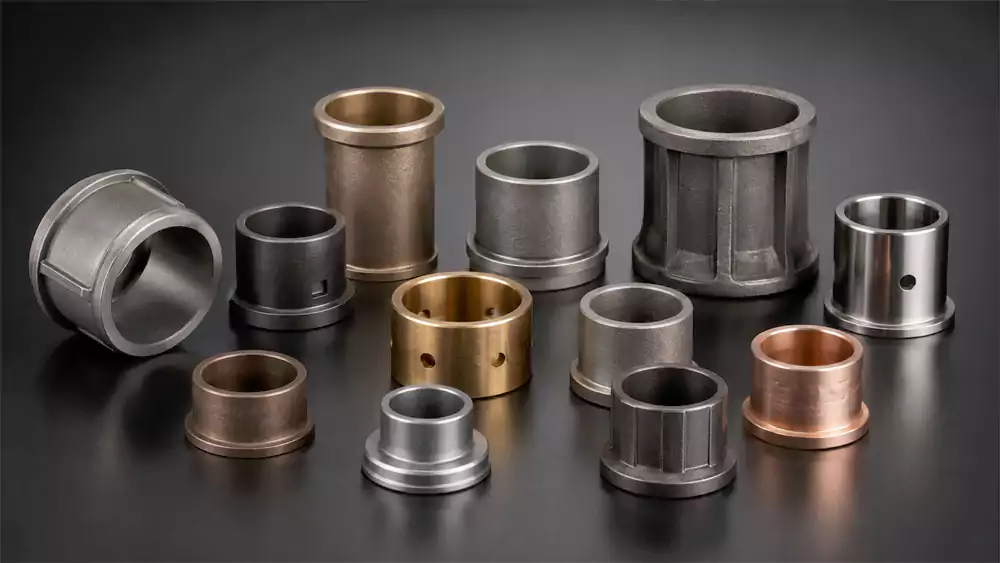
I started my career inside an investment casting workshop. I spent years watching engineers struggle with machining costs, tolerance problems, and material waste. Over time, I learned that a good bushing is not only about machining accuracy. It is also about process balance, material selection, and practical engineering decisions. That is why I believe custom bushings deserve much more attention than most buyers give them.
What Are Custom Bushings and Where Are They Used?
Many engineers focus only on dimensions when sourcing bushings. Then they face wear problems, vibration issues, or expensive maintenance later.
Custom bushings are specially engineered components used to reduce friction, support shafts, improve alignment, and protect moving parts from wear. They are commonly used in automotive systems, industrial machinery, hydraulic equipment, motorcycles, and agricultural machines.
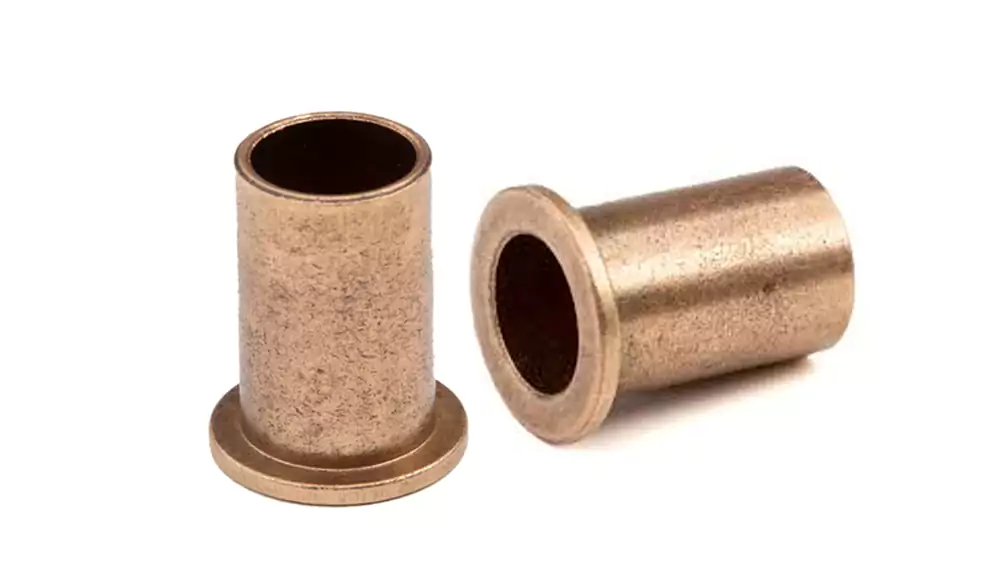
The reason bushings matter so much is simple. They sit directly between moving parts. If the wrong design or material is selected, the entire assembly can suffer from vibration, heat buildup, and premature failure. I learned this very early while working with hydraulic equipment manufacturers that operated under continuous heavy loads.
What Is a Custom Bushing?
A custom bushing is a mechanical component designed for a specific application. It usually sits between two moving parts. Its job is simple. It reduces metal-to-metal contact and improves motion stability.
Unlike standard catalog bushings, custom bushings are made according to exact requirements. Engineers often customize:
- Inner diameter
- Outer diameter
- Wall thickness
- Material
- Surface treatment
- Lubrication grooves
- Tolerance range
I often tell customers that bushings are small parts with very big responsibilities. A poorly designed bushing can damage shafts, bearings, and entire assemblies. Many buyers also compare bushing vs bearing solutions before finalizing their mechanical design because each solution performs differently under load and speed conditions.
Main Functions of Bushings
Reduce Friction
Bushings create a low-friction surface between moving components. This helps reduce heat and energy loss.
Support Rotating Parts
Bushings help maintain shaft alignment during rotation or sliding movement.
Improve Wear Resistance
Proper materials like bronze or PTFE greatly improve service life under heavy loads.
Absorb Shock and Vibration
Many industrial systems generate vibration during operation. Bushings help absorb these forces and reduce equipment stress1.
Industries That Commonly Use Custom Bushings
Automotive
Suspension systems, steering systems, and transmission assemblies all use bushings.
Motorcycle
Motorcycles use lightweight bushings in swingarms, shock absorbers, and wheel systems.
Medical Equipment
Precision bushings support smooth movement in imaging systems and surgical devices.
Agricultural Machinery
Heavy-duty bushings handle dust, shock loads, and long operating hours.
Hydraulic Systems
Hydraulic cylinders use bushings for shaft guidance and sealing support.
Industrial Equipment
Conveyors, pumps, compressors, and robotic systems all rely on precision bushings.
In one project for a hydraulic equipment customer in Germany, we replaced a fully machined carbon steel bushing with an investment cast near-net shape design. The customer reduced machining time by 42% and lowered total component cost by nearly 28%.
| Parameter | Original Design | Optimized Design |
|---|---|---|
| Material | C45 Steel | Cast Carbon Steel |
| Machining Time | 18 min | 10.5 min |
| Concentricity | 0.05 mm | 0.03 mm |
| Annual Quantity | 24,000 pcs | 24,000 pcs |
| Cost Reduction | — | 28% |
As production volumes increased, the customer realized that manufacturing process selection mattered just as much as material choice. That conversation naturally led us into a deeper discussion about bushing types and engineering materials.
Types and Materials of Custom Bushings
Many buyers choose materials based only on price. This often leads to early wear, corrosion, or lubrication failure.
The best custom bushing material depends on operating load, rotation speed, lubrication conditions, corrosion exposure, and working temperature. Bronze, stainless steel, PTFE, brass, and carbon steel are the most common materials used for different industrial applications.
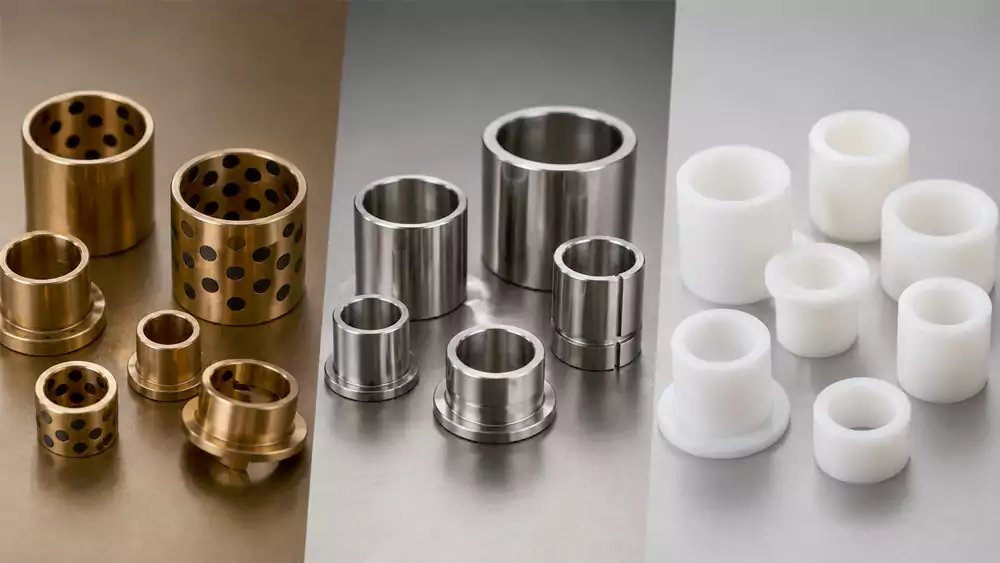
A good bushing design always starts with understanding the actual working environment. I have seen expensive bronze bushings fail simply because lubrication conditions were ignored. I have also seen low-cost carbon steel bushings outperform premium materials because the application was correctly engineered from the beginning.
Common Types of Bushings
Sleeve Bushings
These are the most common type. They provide simple radial support for rotating shafts.
Flanged Bushings
Flanged bushings include a flange section that handles axial loads.
Thrust Bushings
These bushings support axial movement and heavy thrust loads.
Tapered Bushings
Tapered bushings help improve shaft locking and alignment.
Self-Lubricating Bushings
These bushings contain graphite, PTFE, or oil-filled materials for low-maintenance operation.
Best Materials for Custom Bushings
Bronze Bushings
Bronze offers excellent wear resistance and good machinability. It works well in heavy-load applications.
Brass Bushings
Brass provides corrosion resistance and smooth operation under lighter loads.
Stainless Steel Bushings
Stainless steel performs well in wet or corrosive environments.
Carbon Steel Bushings
Carbon steel provides high strength and lower material cost.
PTFE and Plastic Bushings
Plastic bushings reduce noise and work well in dry-running systems.2
How to Choose the Right Material
Engineers usually focus on five major factors.
| Selection Factor | Key Consideration |
|---|---|
| Load | Heavy loads need stronger materials |
| Speed | High speed needs low friction |
| Lubrication | Dry running may require PTFE |
| Corrosion | Wet environments need stainless steel |
| Temperature | High heat changes material stability |
I learned this lesson very early in my career. A customer once selected brass bushings for a high-load agricultural assembly simply because the unit price looked attractive. The bushings failed after only three months. We later switched to tin bronze with graphite lubrication grooves. Service life increased more than four times.
Material selection is only one part of the story. Even the best material can fail if the manufacturing process is not controlled correctly. That is why experienced engineers pay close attention to how custom bushings are actually produced.
How Custom Bushings Are Manufactured
Many suppliers claim they can machine bushings. Very few understand how to optimize the entire manufacturing process.
High-quality custom bushings are manufactured through a combination of investment casting, CNC machining, precision finishing, and strict tolerance control. Using near-net shape casting before machining reduces material waste, shortens machining time, and lowers overall production cost.
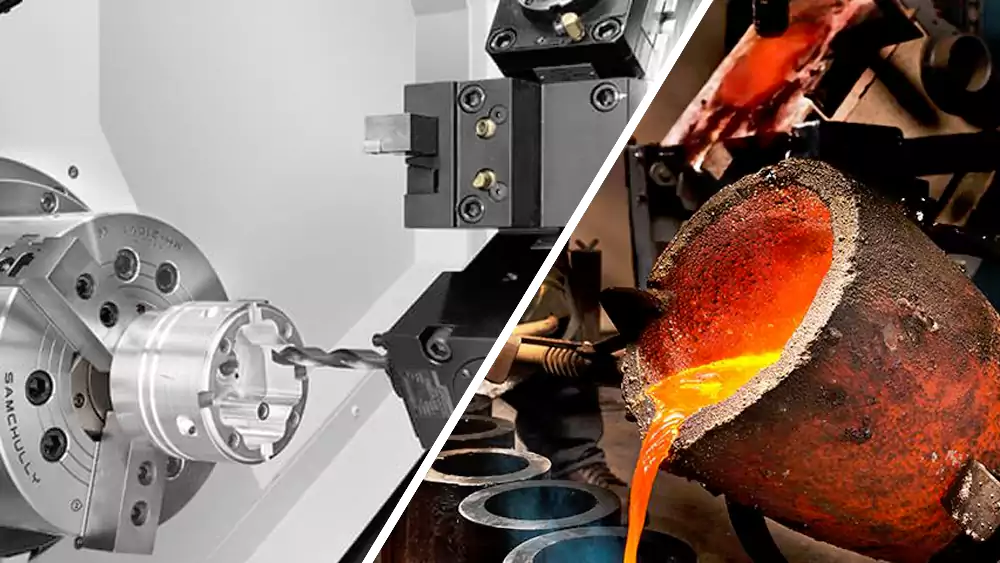
This is the part of the business where I feel most confident because it combines real engineering with practical manufacturing experience. I spent years studying how casting and machining interact together. In many cases, the wrong production method can double the total manufacturing cost3 before the customer even notices the problem.
Investment Casting for Bushings
Investment casting is one of our core strengths at Allied Metal.
I strongly believe many manufacturers waste money by machining bushings directly from solid bar stock. Material waste becomes very high. Machining time also increases sharply.
The smarter solution is to use investment casting to create a near-net shape first. Then CNC turning handles only the critical dimensions. This saves both material and machining cost.
This process works especially well for:
- Complex geometries
- Large flange bushings
- Thick-wall bushings
- Medium-to-high volume production
One aerospace customer required a stainless steel flanged bushing with tight concentricity control.
| Parameter | Requirement |
|---|---|
| Material | ASTM A351 CF8M4 |
| Outer Diameter | 82 mm |
| Inner Diameter | 45 mm |
| Concentricity | ≤0.02 mm |
| Surface Roughness | Ra 1.6 |
| Annual Volume | 12,000 pcs |
We used investment casting to create the near-net blank. Then we finished the bore and flange surfaces with CNC turning and grinding. The final machining allowance was reduced by 55%.
Many engineers ask me whether casting or CNC machining is better for bushings. In reality, the best answer is usually a smart combination of both processes instead of treating them as competing methods.
CNC Machining Process
Turning
Turning creates precise inner and outer diameters.
Milling
Milling machines create oil grooves, slots, and flange features.
Drilling
Drilling adds lubrication holes and assembly features.
Grinding
Grinding improves surface finish and precision tolerance control.
For high-precision OEM projects, we also provide dedicated CNC machining services after casting to achieve critical tolerances and surface finish requirements.
Surface Finishing Options
Polishing
Polishing improves smoothness and appearance.
Zinc Plating
Zinc plating improves corrosion resistance.
Black Oxide
Black oxide creates mild corrosion protection and a clean appearance.
Phosphating
Phosphating improves oil retention and wear resistance.
Quality Control and Tolerances
Dimensional Inspection
We use CMM inspection for critical dimensions.
Material Certification
Material traceability is critical for export markets.
Surface Roughness
Surface finish directly affects wear and lubrication performance.
Concentricity Control
Concentricity is one of the most important requirements in rotating systems.
At Allied Metal, we often inspect concentricity multiple times during production. I learned long ago that correcting tolerance issues after heat treatment is expensive and risky.
A good manufacturing process does not only improve quality. It also directly affects final cost. This becomes very important when OEM buyers compare prototype pricing with mass production planning.
How Much Do Custom Bushings Cost?
Many buyers only compare unit prices. Then they discover hidden costs later in machining, maintenance, or assembly problems.
Custom bushing cost depends mainly on material type, machining complexity, tolerance requirements, production quantity, and surface finishing. Using near-net shape investment casting combined with CNC machining can significantly reduce overall manufacturing cost.
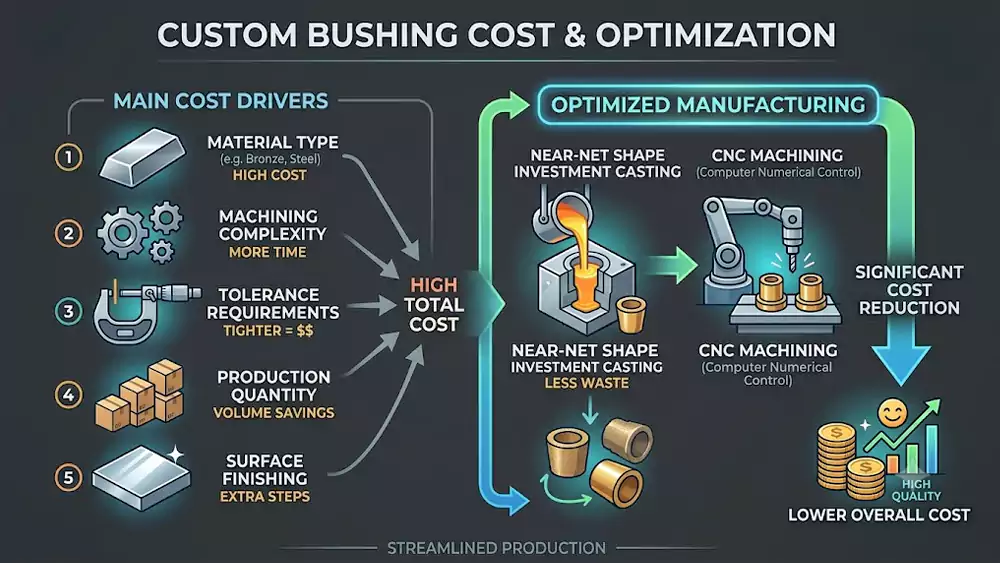
I often explain to customers that the cheapest quote is not always the lowest real cost. A poorly optimized manufacturing process can create high scrap rates, unstable tolerances, and long machining cycles. Those problems eventually become hidden expenses during production.
Main Factors Affecting Cost
Material
Bronze and stainless steel cost more than carbon steel.
Machining Complexity
Complex geometries increase machining time.
Tolerance Requirements
Tighter tolerances require more inspection and precision machining.
Quantity
Higher volumes reduce tooling and setup cost per part.
Surface Treatment
Additional coatings increase process steps and cost.
Prototype vs Mass Production Cost
Prototype production is always more expensive per piece. Setup cost gets divided across fewer units.
Mass production allows:
- Stable tooling
- Faster cycle time
- Better material usage
- Automated inspection
I always explain this clearly to OEM customers. Some buyers focus only on prototype pricing and misunderstand long-term production economics.
How to Reduce Manufacturing Costs
There are several smart ways to lower cost without reducing quality.
| Optimization Method | Benefit |
|---|---|
| Optimize Tolerances | Reduces machining time |
| Simplify Geometry | Improves manufacturability |
| Choose Suitable Material | Balances performance and cost |
| Combine Casting + Machining | Saves material and labor |
This last point is very important.
Relying only on machining solid bar stock for bushings is often throwing money away. Investment casting creates a near-net shape. Then precision machining focuses only on critical surfaces. That is true process expertise.
When customers understand how manufacturing decisions affect long-term reliability and production cost, they usually start looking for a supplier with both engineering experience and real production capability.
Why Choose Allied Metal as Your Custom Bushing Manufacturer?
Many suppliers can machine bushings. Few suppliers truly understand both casting and machining together.
Allied Metal provides custom bushing manufacturing services with investment casting, CNC machining, strict quality control, and OEM engineering support. Our process helps customers reduce machining cost, improve dimensional accuracy, and achieve stable long-term production quality.
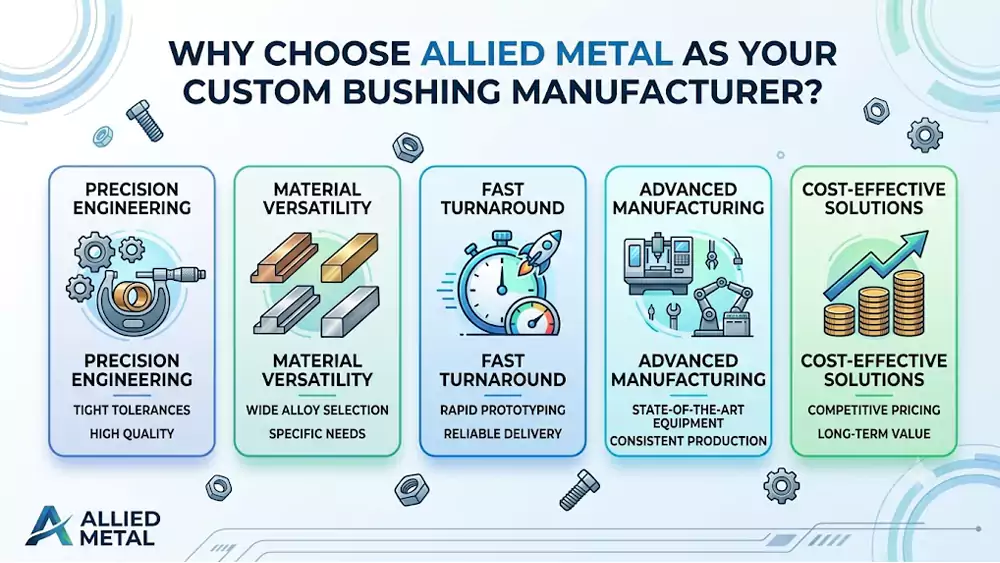
Over the years, I have learned that customers value more than just production capacity. They want honest communication, practical engineering advice, stable quality, and a supplier who understands manufacturing problems before they become expensive failures.
20+ Years of Casting and Machining Experience
I started on the foundry floor myself. I understand both manufacturing reality and engineering requirements.
OEM and Custom Manufacturing Support
We support custom drawings, material selection, and process optimization.
Flexible Production Capacity
We handle both low-volume prototypes and large production orders.
Strict Quality Control for Export Markets
Our customers expect reliable documentation, stable tolerances, and full traceability.
Conclusion
Custom bushings may look like simple components, but they play a critical role in equipment reliability, operating efficiency, and long-term maintenance cost. Over the years, I have seen how the right combination of material selection, investment casting, CNC machining, and precision quality control can completely change the performance of a mechanical system.
For me, successful bushing manufacturing is never about choosing the cheapest process. It is about finding the smartest balance between engineering performance, manufacturability, and cost control. That is why I strongly believe near-net shape investment casting combined with precision machining offers one of the most effective solutions for OEM custom bushing production today.
At Allied Metal, we continue to focus on practical engineering, stable production quality, and honest technical support. Because in real manufacturing, long-term reliability always matters more than short-term savings. If you are developing a custom bushing project, I would be happy to review your drawing and discuss the best manufacturing approach with you.
-
"[PDF] Dynamic impact of ageing dump truck suspension systems on whole ...", https://scholarsmine.mst.edu/cgi/viewcontent.cgi?article=3473&context=doctoral_dissertations. An engineering source on elastomeric or suspension bushings should support that compliant bushings can isolate vibration, accommodate shock loads, and reduce transmitted dynamic forces in mechanical assemblies. Evidence role: mechanism; source type: education. Supports: Bushings can absorb shock and vibration forces and reduce stress transmitted through equipment.. Scope note: This support applies most directly to compliant or elastomeric bushing designs; rigid metallic bushings may guide motion and resist wear without significant vibration isolation. ↩
-
"Metal-Polymer Composite Bearings - DU® Bushings | GGB", https://www.ggbearings.com/en/our-products/metal-polymer-bearings. Tribology and polymer-bearing references report that PTFE and other engineering polymers can provide low-friction, self-lubricating sliding behavior, making them suitable for some dry-running bearing applications and often reducing vibration-related noise compared with metal-to-metal contact. Evidence role: mechanism; source type: paper. Supports: Plastic bushings can reduce noise and work well in dry-running systems.. Scope note: The evidence is contextual rather than universal; noise reduction and dry-running life depend on polymer formulation, load, speed, temperature, and counterface roughness. ↩
-
"A systematic review of decision tools for process selection and ...", https://pmc.ncbi.nlm.nih.gov/articles/PMC12592300/. Manufacturing cost-engineering literature shows that process selection can substantially change total part cost through material utilization, cycle time, tooling, and secondary operations; the source should be used as contextual support rather than proof of an exact twofold increase. Evidence role: general_support; source type: paper. Supports: Choosing an unsuitable production method can greatly increase total manufacturing cost.. Scope note: Likely supports the magnitude and mechanisms of cost variation in general, not this specific bushing scenario or the precise 'double' figure. ↩
-
"A351 CF8M | Austenitic Stainless | Alloy Casting Industries", https://www.alloycasting.com/alloys/austenitic-stainless/a351-cf8m. ASTM A351/A351M defines CF8M as a cast austenitic stainless-steel grade within its specification for austenitic castings, supporting the identification of ASTM A351 CF8M as the specified stainless casting material for the flanged bushing. Evidence role: definition; source type: institution. Supports: ASTM A351 CF8M is a stainless steel casting material specified for the flanged bushing.. Scope note: This supports the material designation and classification, but not the specific customer project details or performance results described in the article. ↩