
Many engineers worry about choosing the wrong metal and ending up with cracks, unstable dimensions, or high machining costs that ruin a project.
Gray cast iron is a cost-effective and stable material with strong damping, good machinability, and predictable casting behavior, making it a reliable choice for industrial components.

I have worked with gray cast iron for more than twenty years, and I learned early that this metal behaves differently from steel or aluminum. It has its own strengths, limits, and small tricks that can decide whether a part succeeds or fails. In this guide, I want to show you the same things I watch for when I stand beside a furnace: how the graphite forms1, how the iron cools, how stress moves through a structure, and how a designer can use these behaviors to their advantage. If you understand these points, you can choose the right grade, the right process, and the right supplier with much more confidence.
What is gray cast iron?
Many customers first come to me thinking gray iron is outdated or too brittle for modern engineering needs.
Gray cast iron is a cast iron alloy with graphite flakes dispersed through its structure, giving it high damping capacity, good machinability, and stable thermal behavior.
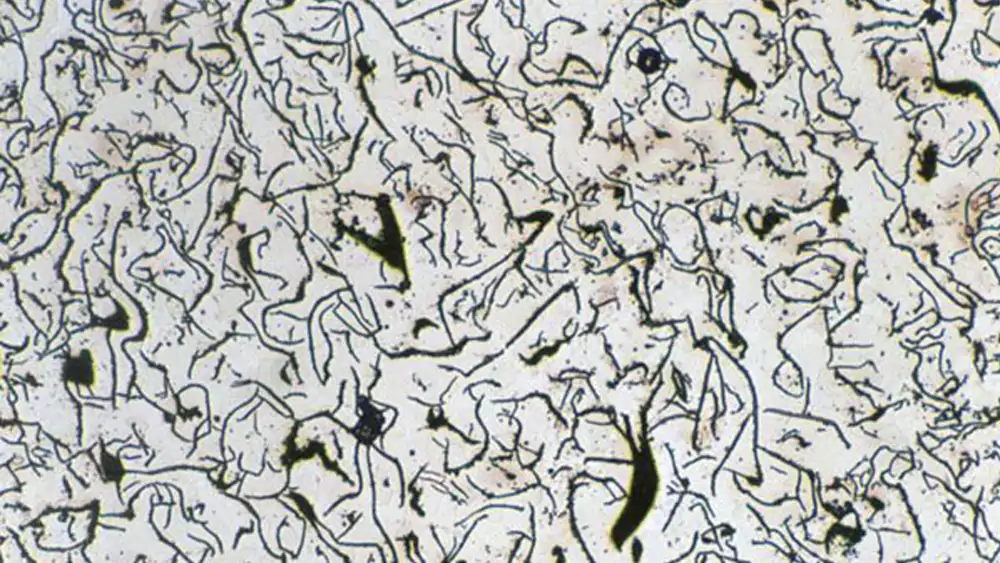
I still remember the first time I poured gray iron as a young technician. The metal solidified fast, and the fracture surface showed the dull gray color that gives the material its name. Those graphite flakes act like tiny shock absorbers. They break up stress waves and make parts naturally quiet and stable. This is why machine tool bases, engine blocks, and pump housings still depend on this material today.
Why the microstructure matters
The graphite structure is the key to everything. Without understanding it, material selection becomes guesswork.
| Feature | Reason | Result |
|---|---|---|
| Graphite flakes | Interrupt metal continuity | Lower tensile strength |
| Graphite lubrication | Reduces friction | Easy machining |
| Carbon-rich matrix | Stable solidification | Predictable casting |
| Stress wave breakup | Discontinuous structure | High vibration damping2 |
Gray iron is not a good choice for high-impact loads or parts that need ductility. But for anything that needs stability, stiffness, or vibration control, it is one of the best options available.
What are the main properties and benefits of gray cast iron?
Many engineers struggle to decide when gray iron is the right material because it behaves differently from steel, ductile iron, or aluminum.
Gray cast iron offers strong vibration damping, predictable thermal behavior, excellent machinability, and low cost, making it ideal for structural housings, machine bases, and high-volume castings.
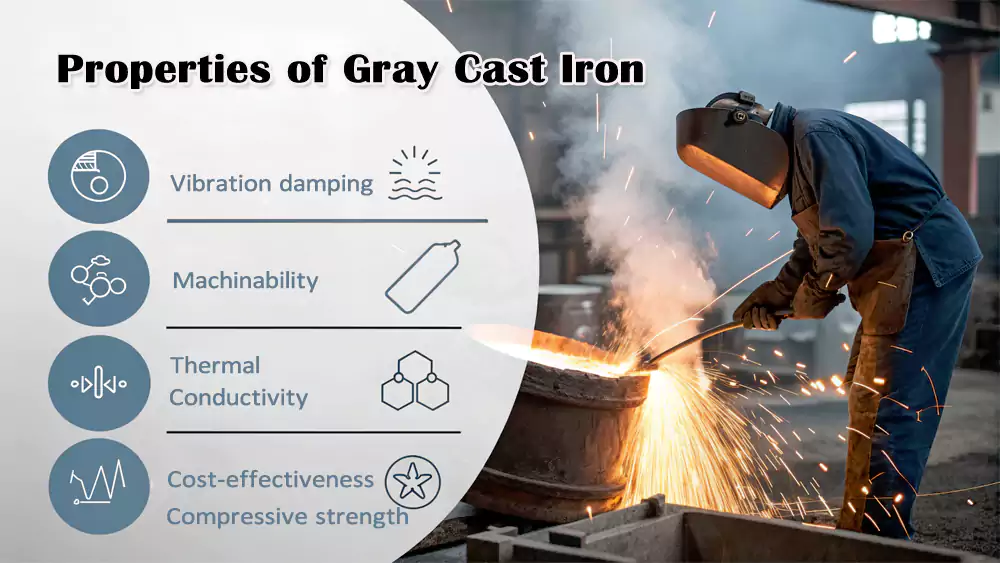
Over the years I have seen gray iron outperform more expensive alloys simply because it handles vibration better and stays dimensionally stable over long operating cycles. Let me explain the key points engineers should care about.
1. Vibration damping
Gray iron is unmatched in this area. The graphite flakes kill vibration and prevent resonance. This is why machine beds, compressor frames, and pump housings are still made from gray iron. Accuracy and quiet operation depend on it.
2. Machinability
The metal cuts smoothly because graphite acts as a natural lubricant. Tools last longer. Chips break easily. Machining time drops. This alone saves many customers thousands of dollars on large production runs.
3. Thermal conductivity
Gray iron moves heat through the structure quickly. This prevents hot spots in engine blocks, brake components, and high-load housings. Good thermal stability also keeps parts from twisting during temperature cycles.
4. Cost efficiency
The melting temperature is low, the casting behavior is stable, and the tooling cost is small. For large components, gray iron still offers unmatched price-performance.
5. Compressive strength
While tensile strength is lower than ductile iron, gray iron has very high compressive strength, which makes it ideal for structural frames and bases.
What casting processes work best for gray cast iron?
Many procurement teams ask me which casting method gives the best balance of accuracy, cost, and delivery time for gray iron.
Gray cast iron performs best with sand casting methods—green sand, resin sand, and shell molding—because they handle large parts well and support stable solidification.

I have poured gray iron in almost every process available in commercial foundries. Here is what I have learned from real production experience.
Green sand casting
This is the most common method. It is perfect for large housings and structural parts. Tooling is simple. The molds breathe well. The surface is not as smooth, but the process is fast and stable.
Resin sand casting
When customers want better surface finish and more dimensional accuracy, resin sand is a strong choice. The molds are stronger, the surfaces are harder, and the castings hold shape well.
Shell molding
I use shell molding for smaller and thinner-walled parts that need tighter tolerances. Tooling cost is higher, but the stability and cleanliness of the molds often justify it.
Why investment casting is not used
Investment casting does not work well for gray iron because the graphite flakes damage the ceramic shell during solidification.
But I mention this because investment casting is excellent for stainless steel, carbon steel, and heat-resistant alloys, which is one of the strengths of Allied Metal when customers need complex shapes or tight tolerances.
Case Study: Precision gray cast iron machine base (EN-GJL-250)
I worked on a gray cast iron machine base for a European automation company that needed a rigid and stable foundation for precision linear rails. Their main problems were vibration, thermal shift, and machining cost.
Project technical data
| Parameter | Value |
|---|---|
| Part name | CNC machine base |
| Material | EN-GJL-250 (ASTM Class 35 equivalent) |
| Casting method | Resin sand casting |
| Final weight | 148 kg |
| Size | 820 × 540 × 280 mm |
| Wall thickness | 16–32 mm |
| Flatness after machining | ≤ 0.08 mm |
| Machining allowance | 3 mm |
| Surface roughness3 | Ra 6.3 µm |
| Hardness | 187–223 HB |
| Required repeatability | ±0.01 mm |
Real manufacturing challenge
The part had heavy thick-to-thin transitions. This created a risk of shrinkage porosity4. I redesigned the gating system and added chills to control solidification. It took two trial pours, but the final structure was dense and stable.
Result
The customer tested the base after 48 hours of thermal cycling5 and confirmed repeatability within ±0.01 mm. They later standardized gray iron for their entire machine frame series.
How should engineers choose gray cast iron grades?
Choosing the right grade can be confusing because strength, damping, and machinability change from one grade to another.
Lower grades offer better damping and machinability, while higher grades provide higher strength and hardness.

I often help engineers select grades by comparing real operating needs rather than only checking datasheets.
Grade overview
EN-GJL-150
Best damping, easiest to machine, lowest strength.
EN-GJL-200 / 250
Most common. Balanced properties. Good for machine housings, pump bodies, and general structures.
EN-GJL-300
Highest strength. Used when heavy static load is more important than damping.
When to choose ductile iron instead
If the part needs impact resistance, bending load capacity, or fatigue strength, ductile iron (EN-GJS series) is the better choice.
But for stability and vibration control, gray iron still wins.
Conclusion
Gray cast iron remains one of the most stable and cost-effective choices for industrial castings that need vibration control, easy machining, and reliable thermal behavior.
Ready to source high-quality gray iron castings?
If you need engineering guidance, fast sampling, or high-precision industrial castings, my team and I at Allied Metal can help you choose the right material, optimize your design, and deliver consistent quality from prototype to mass production.
Contact us to review your drawings and get expert recommendations.
-
This resource will provide insights into the critical role of graphite formation in determining cast iron's characteristics. ↩
-
Exploring vibration damping can reveal how materials like gray iron enhance stability and reduce noise in various applications. ↩
-
View the Complete Surface Finish and Roughness Comparison Guide. ↩
-
Understanding shrinkage porosity is crucial for improving manufacturing processes and ensuring product quality. ↩
-
Exploring thermal cycling can provide insights into material durability and performance in various applications. ↩